Advertisements
Online Mock Tests
Chapters
2: Light
3: Sound
▶ 4: Electricity and Magnetism
5: Heat
6: Modern Physics
![Frank solutions for Physics Part 2 [English] Class 10 ICSE chapter 4 - Electricity and Magnetism - Shaalaa.com](/images/physics-part-2-english-class-10-icse_6:6e65a815841c4e1d9c2ecbfd294c9e9c.jpg "Frank solutions for Physics Part 2 [English] Class 10 ICSE chapter 4 - Electricity and Magnetism")
Advertisements
Solutions for Chapter 4: Electricity and Magnetism
Below listed, you can find solutions for Chapter 4 of CISCE Frank for Physics Part 2 [English] Class 10 ICSE.
Frank solutions for Physics Part 2 [English] Class 10 ICSE 4 Electricity and Magnetism Exercise 4.1 i [Pages 173 - 213]
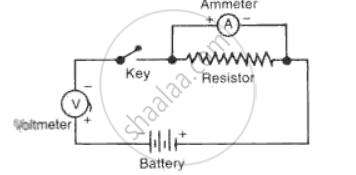
What is wrong with the circuit diagram (Fig. 34)? Carefully check the symbols and assign proper positive and negative signs to them.
On what factors does the resistance of a conductor depend?
A simple electric circuit has 24 V battery and a resistor of 60 Ω. What will be the current in the circuit? The resistance of the connecting wires is negligible.
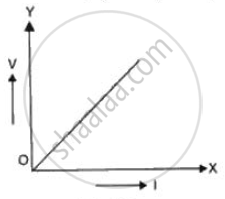
A graph is plotted taking p.d. along y-axis and electric current along x-axis. Name the physical quantity that represents the slope of this graph (Fig.).
Name the following substances:
(i) Showing low resistivity,
(ii) Showing very high resistivity,
(iii) Showing moderate resistivity.
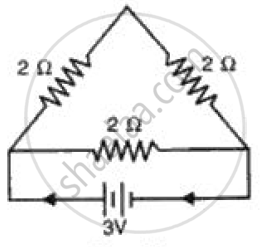
What is the current I in the given circuit (Fig. )?
What is the function of a step-up transformer?
Frank solutions for Physics Part 2 [English] Class 10 ICSE 4 Electricity and Magnetism Exercise 4.1 ii [Page 174]
A simple electric circuit has a 30 V battery and a resistor ot 60 o. What will be the current in the circuit? The resistance of the oonnecting wires is negligible.
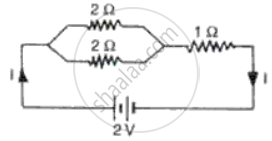
What is the current in the circuit shown (Fig. )
What potential difference is needed to drive a current o f 1 A through a 5 Ω resistor?
A potential difference of 6 V is applied across a 3 Ω resistor. What is the current flowinq throuqh the circuit?
What is the equivalent resistance between A and B in the given circuit (Fig?)
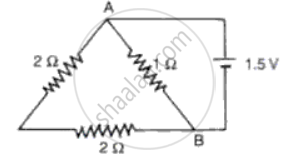
What is the equivalent resistance of 5 equal resistors, each of value 2`Omega` 1 when oonnected in (a) Series ( b) ParaIleI?
How will you oonnect five resistors, each of the value one ohm, to obtain an equivalent resistance of 0.2 `Omega`
Frank solutions for Physics Part 2 [English] Class 10 ICSE 4 Electricity and Magnetism Exercise 4.1 iii [Page 175]
Write the SI units for:
(a) Electric current
(b) Potential difference
(c) Charge.
The work done in moving unit positive charge across two points in an electric circuit is a measure of
Potential difference
Resistance
Power
Current
The device used for measuring potential difference is
Potentiometer
Ammeter
Galvanometer
Voltmeter
A battery of e.m.f. 15 V and internal resistance 3 ohm is connected to two resistors of resistance 3 ohm and 6 ohm in series. Find:
(i) The current through the battery,
(ii) The p.d. between the terminals of the battery.
A uniform wire with a resistance of 27 Ω is divided into three equal pieces and then they are joined in parallel. Find the equivalent resistance of the parallel combination.
You have three resistors of values 2 `Omega`, 3 `Omega`, and 5 `Omega`. How will you join them so that the total resistance is less than 2 `Omega`?
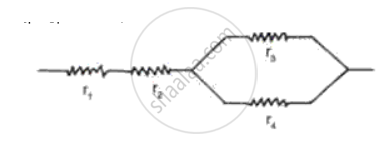
Calculate the equivalent resistance of the following combination of resistor r1, r2, r3, and r4
Frank solutions for Physics Part 2 [English] Class 10 ICSE 4 Electricity and Magnetism Exercise 4.2 i [Page 187]
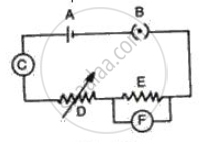
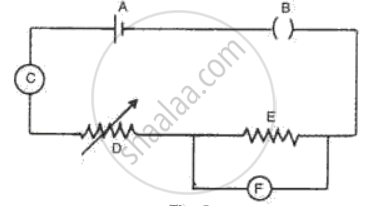
Fig. represents the circuit used for the verification of ohm's law. Label the different parts from A and F. State the function of each.
A 720 W heater operates from a 220 V line voltage. Calculate:
(a) The electrical energy consumed by the heater in 3 h.
(b) The cost of electrical energy consumption at the rate of 60 paise per kWh.
Complete the following sentence:
A fuse is a short piece of wire of high ______ and low ______.
Complete the following sentence:
Fuse wire has a ............ Melting point and it is made of an alloy of ......... and if the current in a circuit rises too high, the fuse wire ...........
Complete the following sentence:
A fuse is connected in ........... with the ......... wire.
Frank solutions for Physics Part 2 [English] Class 10 ICSE 4 Electricity and Magnetism Exercise 4.2 ii [Page 188]
Calculate the amount of energy transferred by a 10 A electric current flowing through a resistor of 5 o for 15 minutes.
A switch is not touched with wet hands while putting it on or off. Give a reason for your answer.
A bulb marked 12 V, 24 W operates on a 12 volt car battery for 20 minutes. Calculate:
(i) The current flowing through it, and
(ii) The energy liberated.
What is international convention of colour coding in a cable?
A current of 0.2 A flows through a wire whose ends are at a potential difference of 15 V. Calculate:
(i) The resistance of the wire, and
(ii) The heat energy produced in 1 minute.
State the S.I. units of electrical power and electrical energy.
(i) Define the household unit of electricity.
(ii) What is the voltage of the electricity that is generally supplied to a house?
Two resistors of 4 Ω and 6 Ω are connected in parallel. The combination is
connected across a 6 volt battery of negligible resistance. Calculate:
( i) The power supplied by the battery,
(ii) The power dissipated in each resistor.
A battery of e.m.f. 15 V and internal resistance 2 `Omega` is connected to tvvo resistors of 4 ohm and 6 ohm joined.
(i) In series,
(ii) In para 1 lel. Find in each case the electrica I energy spent per minute in 6 ohm resistor.
Frank solutions for Physics Part 2 [English] Class 10 ICSE 4 Electricity and Magnetism Exercise 4.2 iii [Page 189]
Frank solutions for Physics Part 2 [English] Class 10 ICSE 4 Electricity and Magnetism Exercise 4.3 i [Page 205]
What is electromagnetic induction?
A coil of copper wire is connected to a galvanometer. What would happen if a bar magnet is:
(i) Pushed into the coil with its north pole entering first?
(ii) Held at rest inside the coil?
(iii) Pulled out again?
Frank solutions for Physics Part 2 [English] Class 10 ICSE 4 Electricity and Magnetism Exercise 4.3 ii [Page 206]
State Fleming’s left hand rule.
The diagram shows two ways of connecting three lamps P, Q and R to A.C. supply of 220 V.
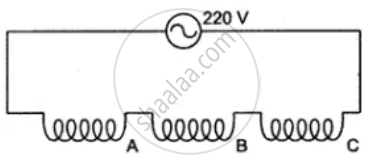
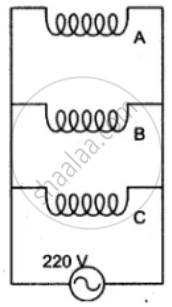
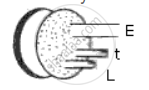
Fig shows a three pin plug top. Label the three pins. Why is the top pin thicker and longer than the other two? Why are the pins splitted at the ends?
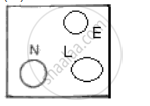
The diagram 31 shows a 3 terminal plug socket.
(i) What is the purpose of the terminal E?
(ii) To which part of the appliance is the terminal E connected?
(iii) To which wire L or N, is the fuse connected and why?
Frank solutions for Physics Part 2 [English] Class 10 ICSE 4 Electricity and Magnetism Exercise 1 [Page 209]
Tick(✓) the correct choice in the following:
In the circuit shown in the following fig, the e.m.f. of the cell is 4 volts, the current
flowing through the resistor is
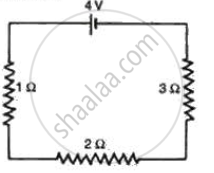
`2/3`A
2 A
1`1/2` A
1`1/3` A
4A
Tick(✓) the correct choice in the following:
When the length of a conductor is doubled the resistance of the conductor
will
Remain same
Double in value
Become four times
Become one fourth
Become half
Tick(✓) the correct choice in the following:
Ohm's law is applicable to
Discharge of electricity through gases
Diode value
All metallic conductors
Carbon compounds
Tick(✓) the correct choice in the following:
24 watt, 12 volt head lamp is fully lit by connecting it to a 12 volt
battery. The working resistance of the lamp is
5Ω
4Ω
1 Ω
6Ω
2Ω
Tick(✓) the correct choice in the following:
Which of the following quantities has the same value for all electrical
appliances connected to the ring main circuit in a house?
Power
Voltage
Resistance
Current
Energy
Tick(✓) the correct choice in the following:
The outer casing of an electric iron is generally connected to earth in order
to
Protect the user from electric shock by short circuiting and consequently
breaking the circuit.Prevent the fuse from burning out.
Protect the iron.
Complete the electrical circuit to the iron.
Allow the current to get away.
Tick(✓) the correct choice in the following:
A three pin plug is connected to the lead for a 1 kW electric iron to be
used on a 250 V supply. Which of the following statements is not correct?
The fuse should be fitted in the I ive wire.
The live wire is coloured brown.
A 13 ampere fuse is the most suitable rating to use.
The yellow and green wire should be connected to the earth pin.
The blue wire should be connected to the neutral side of the mains.
Define the following:
Potential difference
Define the following:
Coulomb
Define the following:
Ohm
Define the following:
Electromotive force
Define the following:
Semiconductors
Define the following:
Super conductors
Frank solutions for Physics Part 2 [English] Class 10 ICSE 4 Electricity and Magnetism Exercise 2 [Page 210]
Fig. represents the circuit used for the verification of Ohm's law. Label the parts from A to F. state the function of each.
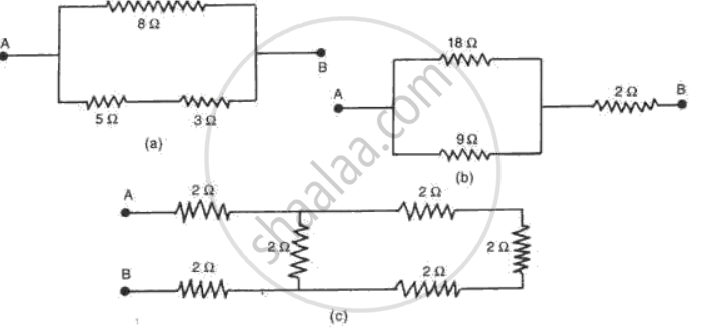
What is the combined resistance of each of the networks between A and B shown in fig. ?
A charge of 80 C flows in a conductor for 2 minutes.
(a) Calculate the current flowing through the conductor.
(b) If the current through a heater is 4 A what charge must be passing in 8 seconds?
The voltage across a 3Ω resistance is 6 V. How large is the current? What is
the resistance of a filament lamp when a voltage of 3 V across it causes a
current of 0.5 A?
Two resistors P and Q of the same material and length but of different thickness are connected in parallel to a battery. The cross- sectional area of P is twice that of Q. What is the ratio of
(a) The resistance of P to the resistance of Q?
(b) The current in P to the current in Q?
Show how would you connect three resistors, each of resistance 6 O so that
the combination has a resistance of(a) 9 Ω (b) 4 .Ω
A battery o f e.m.f. 3 Vis connected in series with an ammeter, a 10 Ω coil of wire and with a parallel combination o f resistance of 3Ω and 6 Ω. Draw a circuit diagram for the above arrangement. What is the
(a) Resistance of the parallel combination?
(b) Reading on the ammeter?
( c) Potential difference across the 3Ω resistor?
( d) Current flowing through each resistor?
Frank solutions for Physics Part 2 [English] Class 10 ICSE 4 Electricity and Magnetism Exercise 3 [Page 211]
Find the effective resistance in the following circuit diagrams (Fig.):
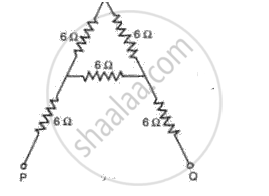
Find the effective resistance in the following circuit diagrams (Fig.):
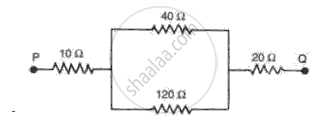
Find the effective resistance in the following circuit diagrams (Fig.):
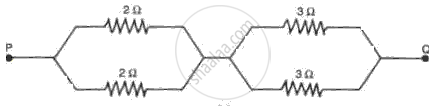
Find the effective resistance in the following circuit diagrams (Fig.):
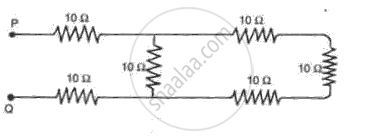
Find the effective resistance in the following circuit diagrams (Fig.):
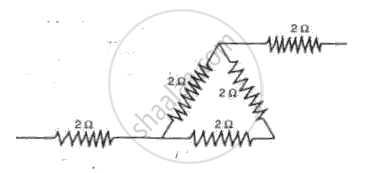
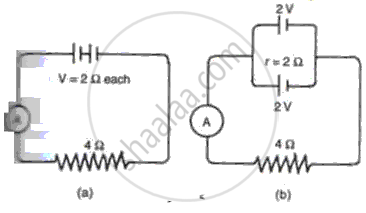
Two cells each having an e.m.f. of 2 V and an internal resistance of 2Ω are
connected (a) In series, and ( b) In para 1le l as shown in fig. . What is the
current flowing through the cir cu it in each_ case?
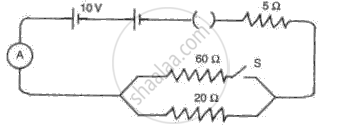
In the circuit shown in fig. 6, find the reading of the ammeter A when the switch S is
(a) Opened.
(b) Closed.
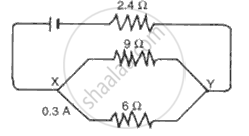
A current of 0.3 A is flowing through a branch of 6 Ω resistors in a junction as shown in fig. . Calculate the
(a) P.d. across the junction XY,
(b) Current flowing through 9Ω and 24Ω
( c) P.d. across 24 Ω resistor, and
( d) e.m.f. of the cell.
Frank solutions for Physics Part 2 [English] Class 10 ICSE 4 Electricity and Magnetism Exercise 4 [Page 212]
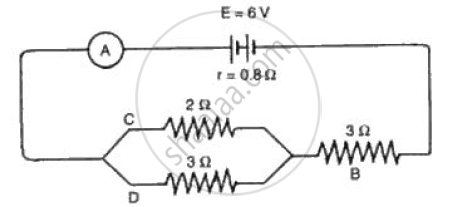
The circuit diagram (Fig.) shows a battery of e.m.f. 6 volts and internal
resistance of 0.8 Ω oonnected in series. Find the
(a) Current reoorded by the ammeter,
(b) P.d. across the terminals of the resistor B,
( c) Current passing through each of the resistors B, C and D, and
( d) P.d. across the terminals of the battery.
Complete the following table. The first answer has been given as an example
| Quantity | Unit |
|
(a) Electrical potential Volt ( b) Resistance ( c) Power ( d) Energy ( e) Resistivity |
Volt ........ .......... ............ .............. |
The following appliances are to be used on 240 V supply. Calculate the current used by each and say which fuse, 2 amp, 5 amp or 13 amp should be incorporated with each, (i) A television rated at 150 W, (ii) An electric iron rated at 750 W, (iii) An immersion heater rated at 3000 W, (iv) A hair dryer rated at 500 W. How much will it cost to run the television set for 100 days for an average of 4 hours a day at 60 paise per unit?
What is the purpose of a fuse in an electrical circuit?
What is the criteria for selecting a fuse wire?
If a fuse contains a 5 A fuse wire and the voltage is 240 V, what is the maximum power (wattage) which may be taken from the circuit?
What would be the danger involved in replacing a blown fuse with the one which would carry a large current?
An electric kettle has a heating element which is rated at 2 kW when connected to a 250 V electric supply. Calculate the
(a) Current which flows in the element when it is connected to a 250 V supply,
(b) Resistance of the filament,
(c) Heat produced in 1 minute by the element,
(d) Cost of running the kettle for 10 minutes a day for 30 days of the month, at the rate of Rs. 3.00 per unit.
60 joules of heat was dissipated in a resistor when 20 C flowed for 5 s. Calculate:
(a) P.d. across the resistor,
(b) Resistance of the resistor, and
(c) Average power dissipated in the resistor.
Fig. shows a 3 pin plug with the cover removed. The electric cable
connected to the plug contains 3 wires with colour coded insulation namely brown, blue and green.
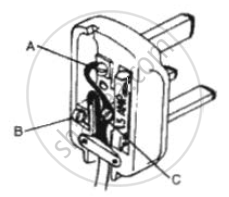
- Identify each of the colour coded wires by stating to which of the
terminals A, B or C in the diagram they should be connected. - Identify the terminal through which no current passes in normal
circumstances. - What is the purpose of the earthed wire connected to an electric
appliance like an electric heater? Describe how it works.
Frank solutions for Physics Part 2 [English] Class 10 ICSE 4 Electricity and Magnetism Exercise 5 [Page 213]
In a house there are 6 bulbs of 100 W each used for 4 hours a day, 4 bulbs of 60 W each used for 8 hours a day, an immersion heater of 2.5 kW used for 1 hour per day, and an electric iron of 800 W used for 2 hours per day. Calculate the cost of monthly electric bill for the month of April at the rate of 80 p per unit.
Name the material and type of wires for the following:
(a) Connecting wires for lighting
(b) Fuse wire
(c) Heating elements
(d) Connecting wires of a power line
(e) Earthing elements
An electric oven is rated as 1.5 kW, 250 V. If it is connected to a 250 V mains, calculate the
(a) Current drawn,
(b) Energy consumed in 20 hours,
(c) Cost of energy consumed in 20 hours at the rate of Re. 1 per unit.
An auto lamp is joined to a battery of e.m.f. 4 V and internal resistance 2.5Ω. A steady current of 0.5 A flows through the circuit. Calculate the
(a) Total energy provided by battery in 10 minutes,
(b) Heat dissipated in the bulb in 10 minutes.
What is meant by a ring circuit in house wiring?
What are the advantages of a parallel connection?
Explain with the help of a diagram how does 'short circuiting' occur in an electric kettle.
Out of the wires- live, neutral and earthing, on which line will you connect the fuse and the switch. Give reason for your answer.
Explain, why is the p.d. between the terminals of a storage battery less when it is supplying current than when it is on open circuit. A battery of e.m.f. 10 volts and internal resistance 2.5 ohms has two resistances of 50 ohms each connected to it. Calculate the power dissipated in each resistance
(a) When they are in series,
(b) When they are in parallel.
In each case calculate the power dissipated in the battery.
Electrical appliances have voltage and power ratings as listed below. Which
has the larger working resistance?
| Appliances | Voltage (V) | Power (W) |
| (a) Washing machine | 250 | 3000 |
| ( b) Television | 240 | 160 |
| (c)240 | 240 | 1500 |
| ( d) Hair curler | 250 | 20 |
| ( e) Car head lamp | 12 | 36 |
If the potential differences between two parts of a thundercloud is 10s V,
what is the amount of energy given up during the passage of 20 coulombs?
(a)2x10⁻⁷J
(b)200J
(c)Sx106 j
(d)2x 10⁹J
(e)2x 10¹⁰ J
A 3 pin mains plug is fitted to the lead for a 1 kW electric kettle to be used on a 250 V A.C. supply. Which of the following statements is NOT correct?
(a) A 13 A fuse is the most appropriate value to use.
(b) The brown wire should be connected to the live side of the mains.
Name the principle on which a transformer works.
Can a transformer work when it is connected to a D.C. source? Give a reason.
Draw a simple labeled diagram of a step-down transformer.
Draw a simple labeled diagram of a step-up transformer.
The diagram 10 shows two coils X and Y. The coil X is connected to a battery S and a key K. The coil Y is connected to a galvanometer G.
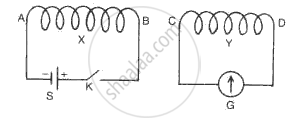
When the key K is closed. State the polarity
(i)At the end of the coil X,
(ii)At the end C of the coil Y,
(iii)At the end C of the coil Y if the coil Y is (a) Moved towards the coil X, (b) Moved away from the coil X.
Frank solutions for Physics Part 2 [English] Class 10 ICSE 4 Electricity and Magnetism Exercise 6 [Page 214]
The following diagram shows a fixed coil of several turns connected to a center zero galvanometer G and a magnet NS which can move in the direction shown in the diagram.
- Describe the observation in the galvanometer if
- The magnet is moved rapidly,
- The magnet is kept still after it has moved into the coil
- The magnet is then rapidly pulled out the coil.
- How would the observation in (i) of part (a) change if a more powerful magnet is used?

Tick (✓) the correct choice among the following :
(a) A strong short bar magnet is dropped into a solenoid connected to a
galvanometer as shown in fig . The galvanometer shows a deflection to the left when the current in the coil as seen from above is counter clockwise. Which one of the following shows the correct deflection of the galvanometer when the magnet is at posi tions A, Band C.
At A At B At C Left left left At A At B At C Left zero zero At A At B At C Left zero right At A At B At C Left right left At A At B At C Left right right
Tick (✓) the correct choice among the following :
Consider two cases of two parallel current carrying conductors. Current in
th e same direction and currents in th e opposi te directions will produce
Attraction and repulsion respectively
Repulsion and attraction respectively,
Attraction in both cases
Repulsion in both cases
Osci llation in both cases
Tick (✓) the correct choice among the following :
Which of the following changes would enable a millimeter to be used as a
direct current ammeter reading upto 1 A?
connecting a large resistor in series
connecting a large resistor in parallel
connecting a small resistor in series
connecting a small resistor in parallel
Tick (✓) the correct choice among the following :
In fig .XY is at right angles to the magnetic field. The direction in
which XY should be moved to induce an electron flow in the direction Y to X as indicated by the arrow is
Along the direction of XY
Towards N and perpendicular to XY,
Towards S and perpendicular to XY
Upwards and perpendicular to XY
Tick (✓) the correct choice among the following :
There are 500 turns and 2000 turns in the primary and secondary coil of a
transformer respectively. If th e output voltage is 1000 V, how large is the
input voltage?
250 v
500 v
1000 v
2000 V
4000 V
Fig . shows the essent ial features of a battery operated bell. The hammer strikes the gong when the swi tch is closed . State and explain the effect of using the following material successively to form the core.
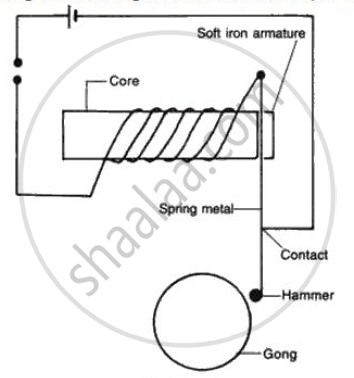
(a) Plastic
(b) Steel
(c) Copper
Frank solutions for Physics Part 2 [English] Class 10 ICSE 4 Electricity and Magnetism Exercise 7 [Page 215]
A wire is passed through a piece of cardboard as shown in fig .. An electric current flows vertically down the wire and then flows back up. The two sections of the write are observed to repel each other.
(a) Wi th the aid of a diagram, describe how you would plot the magnetic field lines on the card .
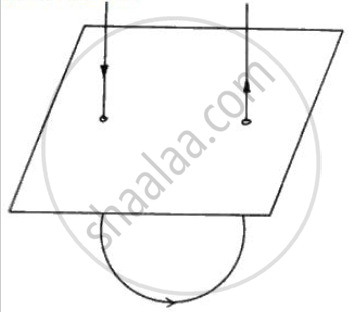
(b) Sketch the magnetic field patterns around both the sections of the wire. Use your sketch to explain why the two sections repel each other.
(c) The repulsive force between the two sections is small. What changes could be made to increase it?
Draw and label the diagram of a simple D.C. motor.
(a) Explain the rotation of the coil, giving a reason for your answer.
(b) How can you reverse the direction of rotation of the armature?
(c) How can you increase the speed of rotation of the motor?
The diagram shows a coil connected to a center zero galvanometerG . The galvanometer shows a deflect ion to the right when the north pole N of a powerful magnet is moved to the right as shown .
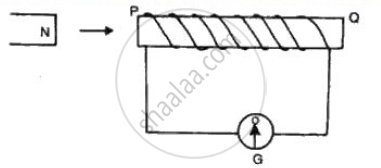
(i) Explain, why the defelct ion occurs in the galvanometer.
(ii ) State whether th e current in the coil is cl ockwise or anticl ockwise
when viewed from the end P.
(iii ) State th e observation in G when the coil is moved away from north
pole N of the magnet keeping the magnet stationary.
(iv)State the observation in G when both the coil and the magnet are
moved to right at th e same speed .
Frank solutions for Physics Part 2 [English] Class 10 ICSE 4 Electricity and Magnetism Exercise 8 [Page 216]
The circuit diagram in fig shows two coils of an insulated copper wire wound on a cardboard tube. G is a center zero galvanometer.
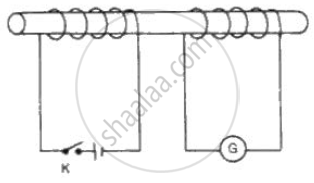
(a) Describe what will happen when th e swi tch K is cl osed for severa l
seconds and then opened again .
(b) What will be the effect of repeating the experiment with an iron placed in the tube?
Fig . shows the core of a transformer and i ts input and output connections
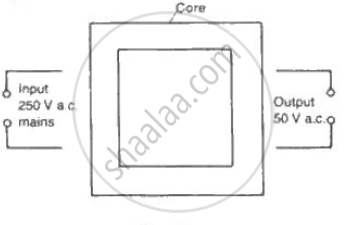
State the material used for the core and describe th e structure of the core.
(a) Use the values given in the diagram to calculate the turns ratio for the transformer and connections, labeling all parts of the diagram .
(b) If a current of 2 A is taken from th e output, calculate th e current in the input circuit (Assume the transformer to be ideal ).
Fig. shows a simple form of an A.C. generator.
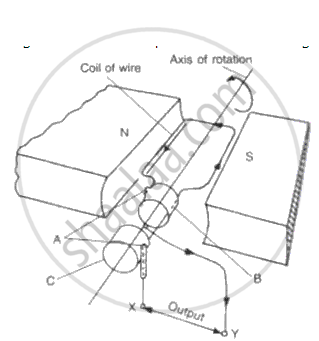
(a) Name the parts labeled A and B.
(b) What would be the effect of doubling the number of turns on the coil if the speed of rotation remains unchanged?
(c) Which of the output terminals is positive if the coil is rotating in the
direction shown in the diagram (anticlockwise)?
( d ) What is the position of the rotating coil when p.d. across its ends is zero? Explain why p.d. is zero when the coil is at this position .
(e) Sketch a graph showing how the p.d. across the ends of the rotating coil varies with time for an A.C. dynamo.
( f) On th e same sheet of paper and vertically below the first graph using the same time scale, sketch graphs to show the effect of
(i) Doubling the speed of rotation and at the same time keeping
the field and the number of turns constant,
(ii ) Doubling the number of turns on the coil and at the same time
doubling the speed of rotation of the coil, keeping th e speed
constant.
Name the type of transformer shown in fig . What changes will you observe regarding the brightness of the lamp, if
(a) The no. of turns in the secondary is doubled?
(b) The part X of the transformer is removed?
( c) The core of the transformer is made out of copper?
(d ) The A.C. supply is replaced by D.C.?
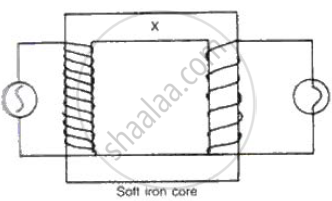
Frank solutions for Physics Part 2 [English] Class 10 ICSE 4 Electricity and Magnetism Exercise 9 [Page 217]
A transformer has 400 turns in the primary winding and 10 turns in the secondary winding. The primary e.m.f. is 250 V and the primary current is 2.0 A. calculate:
(a) The secondary voltage,
(b) The secondary current, assuming 100% efficiency.
Fill in the blanks by writing (i) Only soft iron, (ii) Only steel, (iii) Both soft-iron and steel for the material of core and/or magnet.
Electric bell ______.
Fill in the blanks by writing (i) Only soft iron, (ii) Only steel, (iii) Both soft-iron and steel for the material of core and/or magnet.
Electromagnet ______.
Fill in the blanks by writing (i) Only soft iron, (ii) Only steel, (iii) Both soft-iron and steel for the material of core and/or magnet.
D.C. motor ______.
Fill in the blanks by writing (i) Only soft iron, (ii) Only steel, (iii) Both soft-iron and steel for the material of core and/or magnet.
A. C. generator______.
Fill in the blanks by writing (i) Only soft iron, (ii) Only steel, (iii) Both soft-iron and steel for the material of core and/or magnet.
Transformer______.
The circuit diagram Fig shows three resistors 2 Ω, 4 Ω and R Ω connected to a battery of e.m.f. 2 V and internal resistance 3 Ω. If main current of 0.25 A flows through the circuit, find:
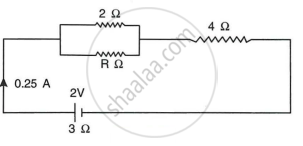
- the p.d. across the 4 Ω resistor,
- the p.d. across the internal resistance of the cell,
- the p.d. across the R Ω or 2 Ω resistors
- the value of R.
A cell supplies a current of 1.2 A through two 2Ω resistors connected in parallel. When the resistors are connected in series, if supplies a current of 0.4 A. Calculate the internal resistance and e.m.f of the cell.
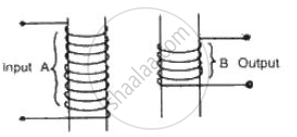
Complete the following diagram of a transformer and name the parts labeled A and B. Name the part you have drawn to complete the diagram . What is the material of this part? In this transformer a step-up or step-down? Why?
Solutions for 4: Electricity and Magnetism
Frank solutions for Physics Part 2 [English] Class 10 ICSE chapter 4 - Electricity and Magnetism
Shaalaa.com has the CISCE Mathematics Physics Part 2 [English] Class 10 ICSE CISCE solutions in a manner that help students grasp basic concepts better and faster. The detailed, step-by-step solutions will help you understand the concepts better and clarify any confusion. Frank solutions for Mathematics Physics Part 2 [English] Class 10 ICSE CISCE 4 (Electricity and Magnetism) include all questions with answers and detailed explanations. This will clear students' doubts about questions and improve their application skills while preparing for board exams.
Further, we at Shaalaa.com provide such solutions so students can prepare for written exams. Frank textbook solutions can be a core help for self-study and provide excellent self-help guidance for students.
Concepts covered in Physics Part 2 [English] Class 10 ICSE chapter 4 Electricity and Magnetism are Electric Resistance, Ohmic and Non-ohmic Resistors, Choice of Material of a Wire, Superconductors, Electromotive Force of a Cell, Terminal Voltage of a Cell, Experimental Verification of Ohm’s Law and Ohmic Resistors, Internal Resistance of a Cell, Electric Current, Resistance of a System of Resistors, Electric Charges, Ohm's Law, Potential Difference, Heating Effect of Electric Current, Resistors in Series, Forms of Energy > Electrical Energy, Measurement of Electrical Energy, Electrical Power, Commercial Unit of Electrical Energy, Power Rating of Common Electrical Appliances, Household Consumption of Electric Energy, Specific Resistance or Electrical Resistivity, Resistors in Parallel, Electric Resistance, Ohmic and Non-ohmic Resistors, Choice of Material of a Wire, Superconductors, Electromotive Force of a Cell, Terminal Voltage of a Cell, Experimental Verification of Ohm’s Law and Ohmic Resistors, Internal Resistance of a Cell, Electric Current, Resistance of a System of Resistors, Electric Charges, Ohm's Law, Potential Difference, Heating Effect of Electric Current, Resistors in Series, Forms of Energy > Electrical Energy, Measurement of Electrical Energy, Electrical Power, Commercial Unit of Electrical Energy, Power Rating of Common Electrical Appliances, Household Consumption of Electric Energy, Specific Resistance or Electrical Resistivity, Resistors in Parallel, Current Rating of a Fuse, Switches, Three-pin Plug and Socket, Circuits with Dual Control Switches (Staircase Wire), Colour Coding of Wires in a Cable, Precautions to Be Taken While Using Electricity, House Wiring (Ring System), Fuse, Transmission of Power from the Power Generating Station to the Consumer, Power Distribution to a House, Earthing, High Tension Wires, Reason for connecting the fuse in the live wire, Applications of Biot-Savart's Law > Magnetic Field Due to a Straight Current-carrying Conductor of Finite Size, Right-hand Thumb Rule, Applications of Ampere’s Circuital Law > Magnetic Field of a Long Straight Solenoid, Permanent Magnet, Uses of Electromagnet, Simple D.C. Motor, Introduction to Electromagnetic Induction, Faraday's Laws of Electromagnetic Induction, Force on a Current-Carrying Conductor Placed in a Uniform Magnetic Field, Alternating-Current Generator, Comparison Between A.C. Generator and D.C. Motor, Transformers, Oersted's Experiment, Electromagnet, Frequency of an a.c. in Household Supplies, Comparison of an Electro Magnet with a Permanent Magnet, Advantages of an Electromagnet over a Permanent Magnet, Electromagnetic Induction: Experimental Demonstration, Faraday's Explanation, Applications of Biot-Savart's Law > Magnetic Field at the Axis of a Circular Current-carrying Loop.
Using Frank Physics Part 2 [English] Class 10 ICSE solutions Electricity and Magnetism exercise by students is an easy way to prepare for the exams, as they involve solutions arranged chapter-wise and also page-wise. The questions involved in Frank Solutions are essential questions that can be asked in the final exam. Maximum CISCE Physics Part 2 [English] Class 10 ICSE students prefer Frank Textbook Solutions to score more in exams.
Get the free view of Chapter 4, Electricity and Magnetism Physics Part 2 [English] Class 10 ICSE additional questions for Mathematics Physics Part 2 [English] Class 10 ICSE CISCE, and you can use Shaalaa.com to keep it handy for your exam preparation.
