Advertisements
Advertisements
Question
Advertisements
Solution
A/c toOhm's law
R = `"V"/"I"`
Here V = 0.1 volt and I = 2 A
R = `0.1/2` = 0.05Ω
APPEARS IN
RELATED QUESTIONS
Judge the equivalent resistance when the following are connected in parallel − (a) 1 Ω and 106Ω, (b) 1 Ω and 103Ω and 106Ω.
If the length of a wire is doubled by taking more of wire, what happens to its resistance?
How does the resistance of a wire change when:
its diameter is tripled?
How will you oonnect five resistors, each of the value one ohm, to obtain an equivalent resistance of 0.2 `Omega`
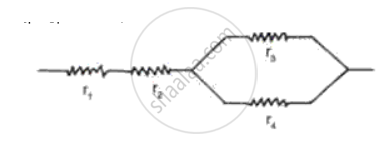
Calculate the equivalent resistance of the following combination of resistor r1, r2, r3, and r4
Two bulbs of 100 W and 40 W are connected in series. The current through the 100 W bulb is 1 A. The current through the 40 W bulb will be ______.
How does the resistance of an alloy, vary with temperature?
Illustrate-combination of cells e.g., three cells, in series, explaining the combination briefly. Obtain an expression for current ‘i’ in the combination.
Two resistors of 4Ω and 6Ω are connected in parallel to a cell to draw 0.5 A current from the cell. Calculate the current in each resistor.
