Advertisements
Advertisements
Question
If the length of a wire is doubled by taking more of wire, what happens to its resistance?
Advertisements
Solution
The area of cross-section of the wire, A = πr2
APPEARS IN
RELATED QUESTIONS
In series combination which remains constant?
(a) Voltage
(b) Current
(c) Both current and voltage
(d) Both are variables
Why is the series arrangement not used for domestic circuits?
(i) Two sets A and B, of three bulbs each, are glowing in two separate rooms. When one of the bulbs in set A is fused, the other two bulbs also cease to glow. But in set B, when one bulb fuses, the other two bulbs continue to glow. Explain why this phenomenon occurs.
(ii) Why do we prefer arrangements of Set B for house circuiting?
How does the resistance of a wire change when:
its length is tripled?
What possible values of resultant resistance one can get by combining two resistances, one of value 2 ohm and the other 6 ohm?
What is (a) highest, and (b)Ω lowest, resistance which can be obtained by combining four resistors having the following resistances?
4 Ω, 8 Ω, 12 Ω, 24 Ω
You are supplied with a number of 100 Ω resistors. How could you combine some of these resistors to make a 250 Ω resistor?
Draw a V-I graph for a conductor at two different temperatures. What conclusion do you draw from your graph for the variation of resistance of conductor with temperature?
What do you mean by power rating of an electrical appliance? How do you use it to calculate
(a) the resistance of the appliance and
(b) the safe limit of the current in it, while in use?
Bends in a rubber pipe reduce the flow of water through it. How would the bands in a wire affect its electric resistance?
Two resistors of 4Ω and 6Ω are connected in parallel to a cell to draw 0.5 A current from the cell. Calculate the current in each resistor.
With the help of a circuit diagram derive the formula for the resultant resistance of three resistances connected:
- in series and
- in parallel
Two wires of the same length and area made of two materials of resistivity ρ1 and ρ2 are connected in series to a source of potential V. The equivalent resistivity for the same area is:
The resistance of the hot filament of the bulb is about 10 times the cold resistance. What will be the resistance of 100 W-220 V lamps, when not in use?
Two electric bulbs have resistances in the ratio 1 : 2. If they are joined in series, the energy consumed in them is in the ratio:
Consider the following combinations of resistors:


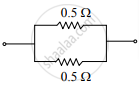
The combinations having equivalent resistance 1 Q is/are ______.
