Advertisements
Advertisements
Question
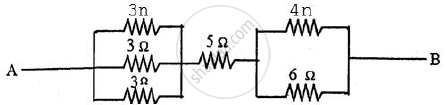
Find the equivalent resistance between points A and B
Advertisements
Solution
As shown in the circuit diagram all the 3Ω resistors re connected in parallel.
`1/R_1=1/3+1/3+1/3`
`R_1=1Omega`
Resistors 4Ω and 6Ω are connected in parallel.
`1/R_2=1/4+1/6=5/12`
`R_2=12/5Omega`
Now R1, R2 and 5Ω are connected in series
`R_(AB)=1+12/5+5`
`R_(AB)=42/5`
`R_(AB)=8.4Omega`
RELATED QUESTIONS
If the equivalent resistance is to be increased, then the number of resistances should be connected in
- Series
- Parallel
- Mixed arrangement
- None of the above
How does the resistance of a wire change when:
its length is tripled?
A p.d. of 4 V is applied to two resistors of 6 Ω and 2 Ω connected in series. Calculate:
(a) the combined resistance
(b) the current flowing
(c) the p.d. across the 6 Ω resistor
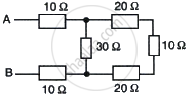
What is the resistance between A and B in the figure given below?
State the effect of rise in temperature on the resistance of semi-conductors.
What is a resistance? Define it with respect to Ohm’s law,
If the current I through a resistor is increased by 100% (assume that temperature remains unchanged), the increase in power dissipated will be:
When a 4 Ω resistor is connected across the terminals of a 2 V battery, the number of coulombs passing through the resistor per second is:
Two electric bulbs have resistances in the ratio 1 : 2. If they are joined in series, the energy consumed in them is in the ratio:
