Advertisements
Advertisements
Question
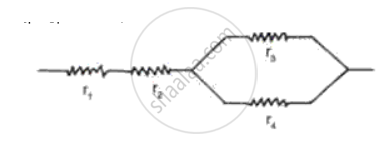
Calculate the equivalent resistance of the following combination of resistor r1, r2, r3, and r4
Advertisements
Solution 1
In the given network, the series combination of resistors, r1 and r2 is connected in series with the parallel combination of resistors, r3 and r4
Equivalent resistance of resistor r1 and r2 , Rs= r1 + r2
Equivalent resistance of resistor r3 and r4 Rp = `[1/ "r"^3 + 1/"r"^4]^-1 = ("r"_3"r"_4)/("r"_3 + "r"_4)`
equivalent resistance of the given network, R = Rs + Rp = r1 + r2 + `("r"_3"r"_4)/("r"_3 + "r"_4)`
Solution 2
Since r3 and r4 are in parallel
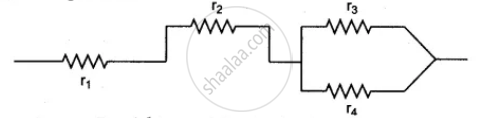
∴ Equivalent resistance R1 of this combination is given by
`1/"R"_1 = 1/"r"_3 + 1/"r"_4 = ("r"_4 + "r"_3)/("r"_4 "r"_3)`
or R1 = `("r"_3 "r"_4)/("r"_3 + "r"_4)`
Now r1, r2 and R1 are in series
∴ Equivalent resistance R of the whole combination is
R = r1 + r2 + `("r"_3 "r"_4)/("r"_3 + "r"_4)`
= `(("r"_1 + "r"_2)("r"_3 + "r"_4) + "r"_3"r"_4)/("r"_3 + "r"_4) Omega`
APPEARS IN
RELATED QUESTIONS
In series combination which remains constant?
(a) Voltage
(b) Current
(c) Both current and voltage
(d) Both are variables
Complete the following :-
(a)

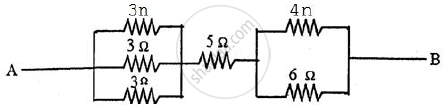
Find the equivalent resistance between points A and B
Two resistances X and Y are connected turn by turn:
- in parallel, and
- in series.
In which case the resultant resistance will be less than either of the individual resistances?
What is a resistance? Define it with respect to Ohm’s law,
Two lamps of resistance 30Ω and 20Ω respectively are connected in series in a 110V circuit. Calculate:
(i) the total resistance in the circuit
(ii) the current in the circuit, and
(iii) the voltage drop across each lamp.
Two resistors of 4Ω and 6Ω are connected in parallel to a cell to draw 0.5 A current from the cell. Calculate the current in each resistor.
Calculate the quantity of heat that will be produced in a coil of resistance 75 Ω if a current of 2A is passed through it for 2 minutes.
Two resistors having 2Ω and 3Ω resistance are connected—(i) in series, and (ii) in parallel. Find the equivalent resistance in each case.
