Advertisements
Advertisements
Question
State and explain the laws of resistance.
Advertisements
Solution
The following are the main laws of resistance:
(i) Resistance of a conductor is directly proportional to its length, provided temperature and other physical conditions remain unchanged.
It means that R ∝ l i.e., if the length increases, the resistance also increases and if length decreases, its resistance also decreases.
(ii) Resistance of a conductor is inversely proportional to its area of cross section, other conditions remaining the same.
If A is the area of cross section, then:
R α `1/"A"`
or R α `1/(pi"r"^2)`
where r is the radius of the wire
Keeping the length same, if the radius of the wire is doubled then:
R α `1/(2"r")^2` α `1/"4r"^2`
or R α `1/4 . 1/(pi"r"^2)`, or R becomes one fourth.
Similarly if r is made half, then:
R α `1/("r"/2)^2`
α `4/"r"^2 α 4 (1/"r"^2)`, orR becomes 4 times
This shows that R is α `1/"A"`
(iii) R depends on the nature of the material of the conductor. It means, if we take equal lengths of wires of copper, aluminium and iron and all of the same cross-sectional area, their resistance are different from each other since they are of different materials.
RELATED QUESTIONS
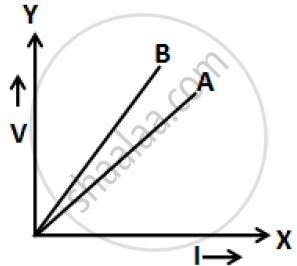
The V-I graph for a series combination and for a parallel combination of two resistors is shown in the figure below. Which of the two A or B. represents the parallel combination? Give reasons for your answer.
An electrical appliance has a resistance of 25 Ω. When this electrical appliance is connected to a 230 V supply line, the current passing through it will be:
(a) 0.92 A
(b) 2.9 A
(c) 9.2 A
(d) 92 A
Name the material which is the best conductor of electricity.
How does the resistance of a pure metal change if its temperature decreases?
How does the resistance of a wire change when:
its diameter is tripled?
How will you oonnect five resistors, each of the value one ohm, to obtain an equivalent resistance of 0.2 `Omega`
Name the material of wire used for making standard resistances. Give a reason.
Define the term resistivity and state its S.I. unit. Which will have higher resistivity a conductor or an insulator.
Three resistors of 6Ω, 3Ω and 2Ω are connected together so that their total resistance is greater than 6Ω but less than 8Ω Draw a diagram to show this arrangement and calculate its total resistance.
A metal wire of resistance 6 Ω is stretched so that its length is increased to twice its original length. Calculate its new resistance.
