Advertisements
Advertisements
Question
Draw a V-I graph for a conductor at two different temperatures. What conclusion do you draw from your graph for the variation of resistance of conductor with temperature?
Advertisements
Solution

In the above graph, T1 > T2. The straight line A is steeper than line B, which leads us to conclude that the resistance of a the conductor is more at high-temperature T1 than at low-temperature T2. Thus, we can say that the resistance of a conductor increases with an increase in temperature.
APPEARS IN
RELATED QUESTIONS
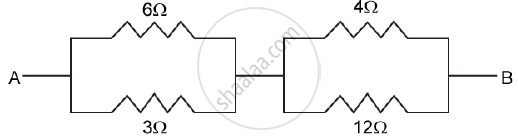
Find the equivalent resistance between A and B
When a 4 Ω resistor is connected across the terminals of a 12 V battery, the number of coulombs passing through the resistor per second is:
(a) 0.3
(b) 3
(c) 4
(d) 12
You are supplied with a number of 100 Ω resistors. How could you combine some of these resistors to make a 250 Ω resistor?
State how are the two resistors joined with a battery when same current flows in each resistor.
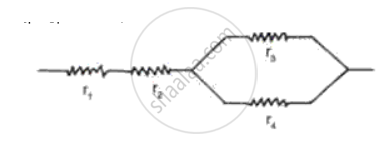
Calculate the equivalent resistance of the following combination of resistor r1, r2, r3, and r4
State the effect of rise in temperature on the resistance of semi-conductors.
Define the term resistivity and state its S.I. unit. Which will have higher resistivity a conductor or an insulator.
Write an expression for calculating electrical power in terms of current and resistance.
Two resistors of 4Ω and 6Ω are connected in parallel to a cell to draw 0.5 A current from the cell.
Draw a labelled circuit diagram showing the above arrangement.
