Advertisements
Advertisements
Question
Complete the following :-
(a)

Advertisements
Solution
(a)

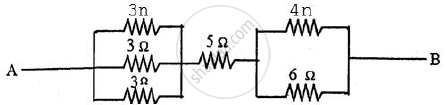
The equivalent resistance is Rs = 12Ω + 2.5Ω + 2.5Ω = 17Ω
APPEARS IN
RELATED QUESTIONS
Why is the series arrangement not used for domestic circuits?
Find the equivalent resistance between points A and B
If the length of a wire is doubled by taking more of wire, what happens to its resistance?
Name the material which is the best conductor of electricity.
Write down an expression for the resistance of a metallic wire in terms of the resistivity.
Give the law of combination of resistances in series.
What possible values of resultant resistance one can get by combining two resistances, one of value 2 ohm and the other 6 ohm?
State how are the two resistors joined with a battery when same current flows in each resistor.
When do you say that the resistors are connected in this way? Draw a circuit diagram.
State expression for Resistance connected in series.
Four resistances of 2.0Ω each are joined end to end, to form a square ABCD. Calculate the equivalent resistance of the combination between any two adjacent comers.
Illustrate-combination of cells e.g., three cells, in parallel, explaining the combination briefly. Obtain an expression for current ‘i’ in the combination.
Two resistors of 4Ω and 6Ω are connected in parallel to a cell to draw 0.5 A current from the cell. Calculate the current in each resistor.
A metal wire of resistance 6 Ω is stretched so that its length is increased to twice its original length. Calculate its new resistance.
With the help of a circuit diagram derive the formula for the resultant resistance of three resistances connected:
- in series and
- in parallel
The resistance of the hot filament of the bulb is about 10 times the cold resistance. What will be the resistance of 100 W-220 V lamps, when not in use?
