Advertisements
Advertisements
Question
In series combination which remains constant?
(a) Voltage
(b) Current
(c) Both current and voltage
(d) Both are variables
Advertisements
Solution
(b) Current
When a potential difference is applied across a combination of resistors in series, the same current flows through each resistor.
APPEARS IN
RELATED QUESTIONS
An electrical appliance has a resistance of 25 Ω. When this electrical appliance is connected to a 230 V supply line, the current passing through it will be:
(a) 0.92 A
(b) 2.9 A
(c) 9.2 A
(d) 92 A
How does the resistance of a pure metal change if its temperature decreases?
How does the resistance of a wire change when:
its length is tripled?
What possible values of resultant resistance one can get by combining two resistances, one of value 2 ohm and the other 6 ohm?
You have three resistors of values 2 `Omega`, 3 `Omega`, and 5 `Omega`. How will you join them so that the total resistance is less than 2 `Omega`?
State the effect of rise in temperature on the resistance of semi-conductors.
Define the term resistivity and state its S.I. unit. Which will have higher resistivity a conductor or an insulator.
State expression for Resistance connected in parallel.
Illustrate-combination of cells e.g., three cells, in parallel, explaining the combination briefly. Obtain an expression for current ‘i’ in the combination.
Two resistors of 4Ω and 6Ω are connected in parallel to a cell to draw 0.5 A current from the cell. Calculate the current in each resistor.
Two wires of same material and same lengths have radii in the ratio of 2 : 3, Compare their resistances.
Two resistors having 2Ω and 3Ω resistance are connected—(i) in series, and (ii) in parallel. Find the equivalent resistance in each case.
Two wires of the same length and area made of two materials of resistivity ρ1 and ρ2 are connected in series to a source of potential V. The equivalent resistivity for the same area is:
In an electrical circuit, two resistors of 2 Ω and 4 Ω respectively are connected in series to a 6 V battery. The heat dissipated by the 4 Ω resistor in 5 s will be ______.
Consider the following combinations of resistors:


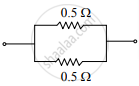
The combinations having equivalent resistance 1 Q is/are ______.
