Advertisements
Advertisements
Question
Four resistances of 2.0Ω each are joined end to end, to form a square ABCD. Calculate the equivalent resistance of the combination between any two adjacent comers.
Advertisements
Solution
The diagram indicates a square ABCD formed by joining four resistances of 2Ω each, end to end.
Let us calculate the equivalent resistance of the combination B between the two adjacent comets C and D.

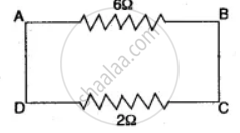
From given figure, arms DA, AB and BC are joined in series.
So, their equivalent of 6Ω and 2Ω are in parallel.
∴ The equivalent resistance of the combination is R.
Then, `1/"R" = 1/6 + 1/2 = 4/6 = 2/3`
∴ R = `3/2` Ω
= 1.5 Ω
RELATED QUESTIONS
Find the expression for the resistors connected in series and write the two characteristics of it. (Draw figure).
Find the expression for resistors connected in series.
How does the resistance of a wire change when:
its length is tripled?
What possible values of resultant resistance one can get by combining two resistances, one of value 2 ohm and the other 6 ohm?
Name a substance of which the resistance remains almost unchanged by the increase in temperature.
Write an expression for calculating electrical power in terms of current and resistance.
Two wires of the same length and area made of two materials of resistivity ρ1 and ρ2 are connected in series to a source of potential V. The equivalent resistivity for the same area is:
If R1 and R2 be the resistance of the filament of 40 W and 60 W respectively operating 220 V, then:
Two electric bulbs have resistances in the ratio 1 : 2. If they are joined in series, the energy consumed in them is in the ratio:
