Advertisements
Advertisements
Question
Consider the following combinations of resistors:


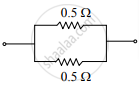
The combinations having equivalent resistance 1 Q is/are ______.
Options
I and IV
Only IV
I and II
I, II and III
Advertisements
Solution
The combinations having equivalent resistance 1 Q is/are I and II.
APPEARS IN
RELATED QUESTIONS
Two resistors of 4Ω and 6 Ω are connected in parallel to a cell to draw 0.5 A current from the cell.
(i) Draw a labelled circuit diagram showing the above arrangement.
(ii) Calculate the current in each resistor. What is an Ohmic resistor?
The substance having infinitely high electrical resistance is called:
(a) conductor
(b) resistor
(c) superconductor
(d) insulator
A p.d. of 4 V is applied to two resistors of 6 Ω and 2 Ω connected in series. Calculate:
(a) the combined resistance
(b) the current flowing
(c) the p.d. across the 6 Ω resistor
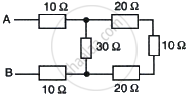
What is the resistance between A and B in the figure given below?
Draw a V-I graph for a conductor at two different temperatures. What conclusion do you draw from your graph for the variation of resistance of conductor with temperature?
Name a substance of which the resistance remains almost unchanged by the increase in temperature.
Why are thick copper wires used as connecting wires?
With the help of a circuit diagram derive the formula for the resultant resistance of three resistances connected:
- in series and
- in parallel
The resistance of the hot filament of the bulb is about 10 times the cold resistance. What will be the resistance of 100 W-220 V lamps, when not in use?
Show how you would connect three resistors, each of resistance 6 Ω, so that the combination has a resistance of 4 Ω.
