Advertisements
Advertisements
प्रश्न
Consider the following combinations of resistors:


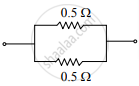
The combinations having equivalent resistance 1 Q is/are ______.
पर्याय
I and IV
Only IV
I and II
I, II and III
Advertisements
उत्तर
The combinations having equivalent resistance 1 Q is/are I and II.
APPEARS IN
संबंधित प्रश्न
(i) Two sets A and B, of three bulbs each, are glowing in two separate rooms. When one of the bulbs in set A is fused, the other two bulbs also cease to glow. But in set B, when one bulb fuses, the other two bulbs continue to glow. Explain why this phenomenon occurs.
(ii) Why do we prefer arrangements of Set B for house circuiting?
If the length of a wire is doubled by taking more of wire, what happens to its resistance?
Calculate the combined resistance in the given case:

Write an expression for the resistance of a conducting wire in terms of its length and area of cross-section.
How does the resistivity of a semiconductor depend on temperature?
Calculate the equivalent resistance between the points A and B for the following combination of resistors:
Illustrate-combination of cells e.g., three cells, in series, explaining the combination briefly. Obtain an expression for current ‘i’ in the combination.
A metal wire of resistance 6 Ω is stretched so that its length is increased to twice its original length. Calculate its new resistance.
With the help of a circuit diagram derive the formula for the resultant resistance of three resistances connected:
- in series and
- in parallel
What is the maximum resistance which can be made using five resistors each of `1/5` W?
