Advertisements
Advertisements
प्रश्न
Calculate the equivalent resistance between P and Q from the following diagram:
Advertisements
उत्तर
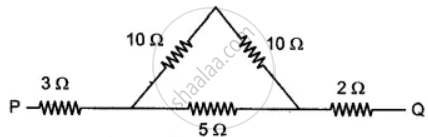
`1/"R"_1 = 1/20 + 1/5`
`1/"R"_1 = (1 + 4)/20 = 5/20`
R1 = 4 Ω
Now, 3 Ω, 4 Ω and 2 Ω in series.
So, R = 3 + 4 + 2 = 9 Ω
संबंधित प्रश्न
Find the expression for the resistors connected in series and write the two characteristics of it. (Draw figure).
Calculate the combined resistance in the given case:

What is (a) highest, and (b)Ω lowest, resistance which can be obtained by combining four resistors having the following resistances?
4 Ω, 8 Ω, 12 Ω, 24 Ω
State how are the two resistors joined with a battery when equivalent resistance is more than either of the two resistances.
How will you oonnect five resistors, each of the value one ohm, to obtain an equivalent resistance of 0.2 `Omega`
State expression for Resistance connected in series.
State a relation between electrical power, resistance and potential difference in an electrical circuit.
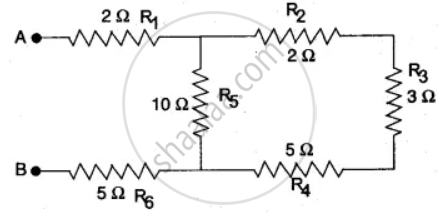
Six resistances are connected together as shown in the figure. Calculate the equivalent resistance between points A and B.
The resistance of two resistors joined in series is 8Ω and in parallel is 1.5Ω. Find the value of the two resistances.
