Advertisements
Advertisements
प्रश्न
Two lamps of resistance 30Ω and 20Ω respectively are connected in series in a 110V circuit. Calculate:
(i) the total resistance in the circuit
(ii) the current in the circuit, and
(iii) the voltage drop across each lamp.
Advertisements
उत्तर
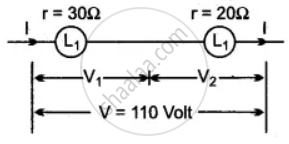
(i) Since the two lamps are connected in series, their total resistance R is given by:
R = R1 + R2
= 30 Ω + 20 Ω = 50 Ω
(ii) We have, V = 110 volt, R = 50 Ω
∴ By Ohm's law
I = `"V"/"R" = 110/50`A = 2.2 A
(iii) We now have
I = 2.2 A
∴ V1 = IR1 = 2.2 × 30V = 66 V
∴ Voltage frop across L1 = 66 V
Similarly, V2 = IR2 = 2.2 × 20 = 44 V
∴ Voltage drop across L2 = 44 V.
संबंधित प्रश्न
Judge the equivalent resistance when the following are connected in parallel − (a) 1 Ω and 106Ω, (b) 1 Ω and 103Ω and 106Ω.
The substance having infinitely high electrical resistance is called:
(a) conductor
(b) resistor
(c) superconductor
(d) insulator
Name the material which is the best conductor of electricity.
Write down an expression for the resistance of a metallic wire in terms of the resistivity.
What potential difference is needed to drive a current o f 1 A through a 5 Ω resistor?
How will you oonnect five resistors, each of the value one ohm, to obtain an equivalent resistance of 0.2 `Omega`
When do you say that the resistors are connected in this way? Draw a circuit diagram.
Bends in a rubber pipe reduce the flow of water through it. How would the bands in a wire affect its electric resistance?
State expression for Resistance connected in parallel.
If the current I through a resistor is increased by 100% (assume that temperature remains unchanged), the increase in power dissipated will be:
