Advertisements
Advertisements
प्रश्न
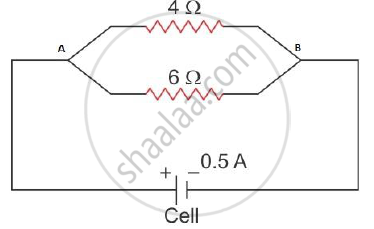
Two resistors of 4Ω and 6 Ω are connected in parallel to a cell to draw 0.5 A current from the cell.
(i) Draw a labelled circuit diagram showing the above arrangement.
(ii) Calculate the current in each resistor. What is an Ohmic resistor?
Advertisements
उत्तर
i.
The parallel combination of two resistors 4 Ω and 6 Ω that draws a current of 0.5 A from the cell is as shown below.
ii.
In parallel combination of resistors potential difference across each resistor is same as the potential difference across the terminals of the battery.
Here current drawn from cell, I = 0.5 A
The effective resistance `1/R=1/R_1+1/R_2`
Here R1=4Ω and R2=6Ω
`therefore 1/R=1/4+1/6`
`therefore 1/R=5/12`
`therefore R=12/5`
`therefore R=2.4 Omega`
APPEARS IN
संबंधित प्रश्न
(i) Two sets A and B, of three bulbs each, are glowing in two separate rooms. When one of the bulbs in set A is fused, the other two bulbs also cease to glow. But in set B, when one bulb fuses, the other two bulbs continue to glow. Explain why this phenomenon occurs.
(ii) Why do we prefer arrangements of Set B for house circuiting?
State how are the two resistors joined with a battery when equivalent resistance is more than either of the two resistances.
To increase the effective resistance in a circuit, the resistors are connected in _______________ .
Answer the following question.
While studying the dependence of potential difference ( V) across a resistor on the current (I) passing through it, in order to determine the resistance of the resistor, a student took 5 readings for different values of current and plotted a graph between V and t. He got a straight line graph passing through the origin. What does the straight-line signify? Write the method of determining the resistance of the resister using this graph.
A metal wire of resistance 6 Ω is stretched so that its length is increased to twice its original length. Calculate its new resistance.
Calculate the quantity of heat that will be produced in a coil of resistance 75 Ω if a current of 2A is passed through it for 2 minutes.
