Advertisements
Advertisements
प्रश्न
Advertisements
उत्तर
A/c to Ohm's law,
R = `"V"/"I" = 20/2` = 10 Ω
APPEARS IN
संबंधित प्रश्न
Name the material which is used for making the heating element of an electric iron.
Name the following substance showing low resistivity.
To increase the effective resistance in a circuit, the resistors are connected in _______________ .
Name the material of wire used for making standard resistances. Give a reason.
State the effect of rise in temperature on the resistance of semi-conductors.
Six resistances are connected together as shown in the figure. Calculate the equivalent resistance between points A and B.
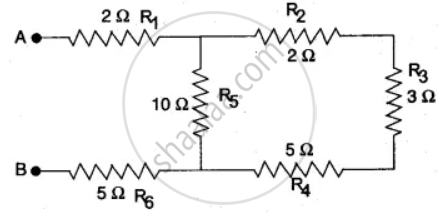
Two resistors of 4Ω and 6Ω are connected in parallel to a cell to draw 0.5 A current from the cell. Calculate the current in each resistor.
What should be the length of a nickel wire of area of cross-section 3 mm2 used for making a rheostat of 750 ohm? (ρ of nickle = 0.069 Ohm mm2/m)
If R1 and R2 be the resistance of the filament of 40 W and 60 W respectively operating 220 V, then:
