Advertisements
Advertisements
प्रश्न
Advertisements
उत्तर
The obstruction offered to the flow of current by the wire is called its electrical resistance. It is a kind of friction between the free electrons and the atoms of the conductor along which they flow.
Its SI unit is 'ohm'.
APPEARS IN
संबंधित प्रश्न
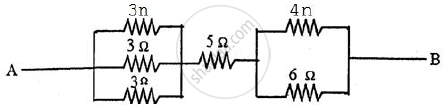
Find the equivalent resistance between points A and B
If the length of a wire is doubled by taking more of wire, what happens to its resistance?
State how are the two resistors joined with a battery when equivalent resistance is more than either of the two resistances.
What potential difference is needed to drive a current o f 1 A through a 5 Ω resistor?
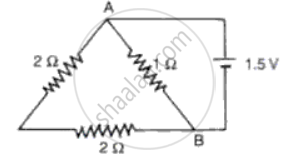
What is the equivalent resistance between A and B in the given circuit (Fig?)
Write an expression for calculating electrical power in terms of current and resistance.
Six equal resistors of 1 ohm each are connected to form the sides of a hexagon ABCDEF. Calculate the resistance offered by the combination if the current enters at A and leaves it at D.
In an electrical circuit, two resistors of 2 Ω and 4 Ω respectively are connected in series to a 6 V battery. The heat dissipated by the 4 Ω resistor in 5 s will be ______.
