Advertisements
Advertisements
प्रश्न
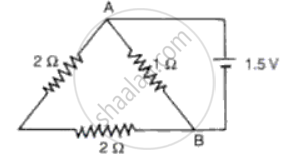
What is the equivalent resistance between A and B in the given circuit (Fig?)
Advertisements
उत्तर
Between A and B, the series combination of two resistors of resistances 2 ohm each is connected in parallel with the 1 ohm resistor.
:. Equivalent series resistance between A and B, R, = 2+2 = 4 Ω
Now, between A and B this 4 Ω resistor is connected in parallel with 1Ω resistor.
Equivalent resistance between A and B, R = `(1/4 + 1/1)^-1= (5/4)^-1 = 4/5`Ω
APPEARS IN
संबंधित प्रश्न
(i) Two sets A and B, of three bulbs each, are glowing in two separate rooms. When one of the bulbs in set A is fused, the other two bulbs also cease to glow. But in set B, when one bulb fuses, the other two bulbs continue to glow. Explain why this phenomenon occurs.
(ii) Why do we prefer arrangements of Set B for house circuiting?
A p.d. of 4 V is applied to two resistors of 6 Ω and 2 Ω connected in series. Calculate:
(a) the combined resistance
(b) the current flowing
(c) the p.d. across the 6 Ω resistor
The diagram below shows part of a circuit:
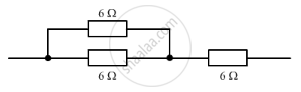
If this arrangement of three resistors was to be replaced by a single resistor, its resistance should be:
(a) 9 Ω
(b) 4 Ω
(c) 6 Ω
(d) 18 Ω
State the order of resistivity of (i) a metal, (ii) a semiconductor and (iii) an insulator.
State how are the two resistors joined with a battery when equivalent resistance is more than either of the two resistances.
When do you say that the resistors are connected in this way? Draw a circuit diagram.
Write an expression for calculating electrical power in terms of current and resistance.
Four resistances of 2.0Ω each are joined end to end, to form a square ABCD. Calculate the equivalent resistance of the combination between any two adjacent comers.
What is the equivalent resistance between the points X and Y for the given network?
