Advertisements
Advertisements
प्रश्न
Six equal resistors of 1 ohm each are connected to form the sides of a hexagon ABCDEF. Calculate the resistance offered by the combination if the current enters at A and leaves it at D.
Advertisements
उत्तर
From figure it is clear that there are two sets of parallel resistances between A and D. Each group has three resistances of 1Ω each, in series.
Equivalent resistance R1 of one group (AB, BC and CD) = 1Ω + 1Ω + 1Ω = 3Ω
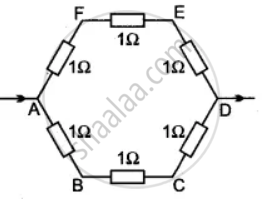
Similarly equivalent resistance R2 of the other group (AF, FE, ED)
= 1Ω + 1Ω + 1Ω = 3Ω
As the two groups are in parallel, we have
`1/"R" = 1/"R"_1 + 1/"R"_2 = 1/3 + 1/3 = 2/3`
where R is the equivalent resistance of the whole combonation.
∴ R = `3/2` Ω or 1.5 Ω.
संबंधित प्रश्न
Complete the following :-
(a)

Two resistors of 4Ω and 6 Ω are connected in parallel to a cell to draw 0.5 A current from the cell.
(i) Draw a labelled circuit diagram showing the above arrangement.
(ii) Calculate the current in each resistor. What is an Ohmic resistor?
(i) Two sets A and B, of three bulbs each, are glowing in two separate rooms. When one of the bulbs in set A is fused, the other two bulbs also cease to glow. But in set B, when one bulb fuses, the other two bulbs continue to glow. Explain why this phenomenon occurs.
(ii) Why do we prefer arrangements of Set B for house circuiting?
How does the resistance of a pure metal change if its temperature decreases?
How does the presence of impurities in a metal affect its resistance?
Two resistances X and Y are connected turn by turn:
- in parallel, and
- in series.
In which case the resultant resistance will be less than either of the individual resistances?
State expression for Resistance connected in series.
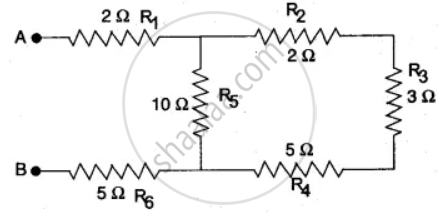
Six resistances are connected together as shown in the figure. Calculate the equivalent resistance between points A and B.
Three resistors of 6Ω, 3Ω and 2Ω are connected together so that their total resistance is greater than 6Ω but less than 8Ω Draw a diagram to show this arrangement and calculate its total resistance.
