Advertisements
Advertisements
प्रश्न
Six equal resistors of 1 ohm each are connected to form the sides of a hexagon ABCDEF. Calculate the resistance offered by the combination if the current enters at A and leaves it at D.
Advertisements
उत्तर
From figure it is clear that there are two sets of parallel resistances between A and D. Each group has three resistances of 1Ω each, in series.
Equivalent resistance R1 of one group (AB, BC and CD) = 1Ω + 1Ω + 1Ω = 3Ω
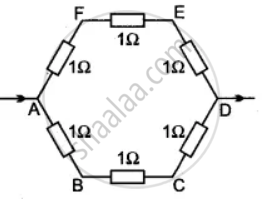
Similarly equivalent resistance R2 of the other group (AF, FE, ED)
= 1Ω + 1Ω + 1Ω = 3Ω
As the two groups are in parallel, we have
`1/"R" = 1/"R"_1 + 1/"R"_2 = 1/3 + 1/3 = 2/3`
where R is the equivalent resistance of the whole combonation.
∴ R = `3/2` Ω or 1.5 Ω.
संबंधित प्रश्न
Write any two characteristics of a series combination of resistors.
Two resistances X and Y are connected turn by turn:
- in parallel, and
- in series.
In which case the resultant resistance will be less than either of the individual resistances?
Name the material of wire used for making standard resistances. Give a reason.
What material is used for making wire to prepare heating coils? Give a reason.
State the effect of rise in temperature on the resistance of semi-conductors.
What is a resistance? Define it with respect to Ohm’s law,
Two lamps of resistance 30Ω and 20Ω respectively are connected in series in a 110V circuit. Calculate:
(i) the total resistance in the circuit
(ii) the current in the circuit, and
(iii) the voltage drop across each lamp.
Calculate the quantity of heat that will be produced in a coil of resistance 75 Ω if a current of 2A is passed through it for 2 minutes.
If R1 and R2 be the resistance of the filament of 40 W and 60 W respectively operating 220 V, then:
Two electric bulbs have resistances in the ratio 1 : 2. If they are joined in series, the energy consumed in them is in the ratio:
