Advertisements
Advertisements
Question
Six equal resistors of 1 ohm each are connected to form the sides of a hexagon ABCDEF. Calculate the resistance offered by the combination if the current enters at A and leaves it at D.
Advertisements
Solution
From figure it is clear that there are two sets of parallel resistances between A and D. Each group has three resistances of 1Ω each, in series.
Equivalent resistance R1 of one group (AB, BC and CD) = 1Ω + 1Ω + 1Ω = 3Ω
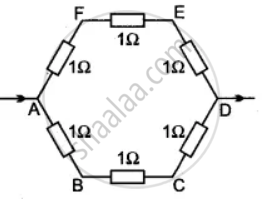
Similarly equivalent resistance R2 of the other group (AF, FE, ED)
= 1Ω + 1Ω + 1Ω = 3Ω
As the two groups are in parallel, we have
`1/"R" = 1/"R"_1 + 1/"R"_2 = 1/3 + 1/3 = 2/3`
where R is the equivalent resistance of the whole combonation.
∴ R = `3/2` Ω or 1.5 Ω.
RELATED QUESTIONS
If the equivalent resistance is to be increased, then the number of resistances should be connected in
- Series
- Parallel
- Mixed arrangement
- None of the above
Two resistors of 4Ω and 6 Ω are connected in parallel to a cell to draw 0.5 A current from the cell.
(i) Draw a labelled circuit diagram showing the above arrangement.
(ii) Calculate the current in each resistor. What is an Ohmic resistor?
An electrical appliance has a resistance of 25 Ω. When this electrical appliance is connected to a 230 V supply line, the current passing through it will be:
(a) 0.92 A
(b) 2.9 A
(c) 9.2 A
(d) 92 A
The diagram below shows part of a circuit:
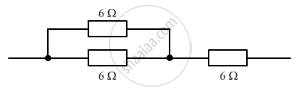
If this arrangement of three resistors was to be replaced by a single resistor, its resistance should be:
(a) 9 Ω
(b) 4 Ω
(c) 6 Ω
(d) 18 Ω
You are supplied with a number of 100 Ω resistors. How could you combine some of these resistors to make a 250 Ω resistor?
Choose the correct alternative and rewrite the following sentence.
If three resistors 2 ohms, 3 ohms and 4 ohms are connected in series, then the effective resistance in the circuit will be _______ ohms.
Name the material of wire used for making standard resistances. Give a reason.
State expression for Cells connected in parallel.
Write an expression for calculating electrical power in terms of current and resistance.
What is a resistance? Define it with respect to Ohm’s law,
