Advertisements
Advertisements
Question
Calculate the equivalent resistance between P and Q from the following diagram:
Advertisements
Solution
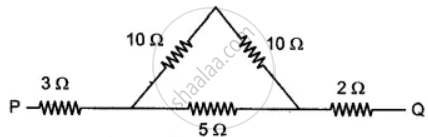
`1/"R"_1 = 1/20 + 1/5`
`1/"R"_1 = (1 + 4)/20 = 5/20`
R1 = 4 Ω
Now, 3 Ω, 4 Ω and 2 Ω in series.
So, R = 3 + 4 + 2 = 9 Ω
RELATED QUESTIONS
A piece of wire of resistance R is cut into five equal parts. These parts are then connected in parallel. If the equivalent resistance of this combination is R’, then the ratio `"R"/"R'"` is ______.
The substance having infinitely high electrical resistance is called:
(a) conductor
(b) resistor
(c) superconductor
(d) insulator
What is (a) highest, and (b)Ω lowest, resistance which can be obtained by combining four resistors having the following resistances?
4 Ω, 8 Ω, 12 Ω, 24 Ω
When do you say that the resistors are connected in this way? Draw a circuit diagram.
How does the resistance of an alloy, vary with temperature?
How does the resistivity of an alloy such as constantace depends on temperature.
Calculate the equivalent resistance between the points A and B for the following combination of resistors:
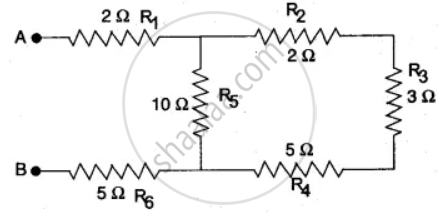
Six resistances are connected together as shown in the figure. Calculate the equivalent resistance between points A and B.
Three resistors of 6Ω, 3Ω and 2Ω are connected together so that their total resistance is greater than 6Ω but less than 8Ω Draw a diagram to show this arrangement and calculate its total resistance.
When a 4 Ω resistor is connected across the terminals of a 2 V battery, the number of coulombs passing through the resistor per second is:
