Advertisements
Advertisements
Question
When do you say that the resistors are connected in this way? Draw a circuit diagram.
Advertisements
Solution
Resistors connected in series: - If the number of resistance are connected one after another in such a way that the same current flows through each resistance, then the arrangement is called resistance in series.
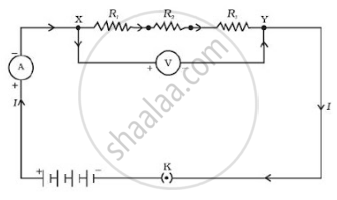
Let R1, R2, and R3 are three resistances connected in a series combination and let be their effective resistance in the circuit.
Let V1, V2, and V3 be the P.D. across resistances R1, R2, and R3 respectively. Let ‘V’ be the P.D. of the cell. Let ‘I’ be the current flow through each resistance.
According to Ohm’s Law,
Conclusion:
If the resistors are connected in series then.
- In a circuit, the current is the same in every part of the circuit.
- The resistance of the combination of resistors is equal to the sum of the individual resistors.
- The total voltage across the combination is equal to the sum of the voltage drop across the separate resistors.
- The effective resistance in a series combination is greater than the individual resistances.
- This combination is used to increase resistance in a circuit.
APPEARS IN
RELATED QUESTIONS
Name the material which is used for making the heating element of an electric iron.
In series combination of resistances ______.
Name the following substance showing low resistivity.
What do you mean by power rating of an electrical appliance? How do you use it to calculate
(a) the resistance of the appliance and
(b) the safe limit of the current in it, while in use?
How does the resistance of an alloy, vary with temperature?
Name the material of wire used for making standard resistances. Give a reason.
What material is used for making wire to prepare heating coils? Give a reason.
State the effect of rise in temperature on the resistance of semi-conductors.
How does the resistivity of a semiconductor depend on temperature?
The voltage applied to a given rheostat is made four times its initial value. By what factor will be resistance of the rheostat change?
Write an expression for calculating electrical power in terms of current and resistance.
You are provided with three resistors of resistance 1.0 Ω, 2.0 Ω and 3.0 Ω How would you connect them to obtain the total effective resistance 1.5 Ω? Draw diagram of the arrangement and check it by calculations.
Calculate the equivalent resistance between the points A and B for the following combination of resistors:
What is the equivalent resistance between the points X and Y for the given network?
Calculate the value of the resistance which must be connected to a 15 ohm resistance to provide on effective resistance of 6 ohm.
In an electrical circuit, two resistors of 2 Ω and 4 Ω respectively are connected in series to a 6 V battery. The heat dissipated by the 4 Ω resistor in 5 s will be ______.
Two electric bulbs have resistances in the ratio 1 : 2. If they are joined in series, the energy consumed in them is in the ratio:
