Advertisements
Advertisements
Question
State a relation between electrical power, resistance and potential difference in an electrical circuit.
Advertisements
Solution
In an electrical circuit, electrical power
P = V2/R
where V = potential difference and R = resistance.
APPEARS IN
RELATED QUESTIONS
Name the material which is the best conductor of electricity.
How does the resistance of a pure metal change if its temperature decreases?
Give one example to show how the resistance depends on the nature of material of the conductor.
What is (a) highest, and (b)Ω lowest, resistance which can be obtained by combining four resistors having the following resistances?
4 Ω, 8 Ω, 12 Ω, 24 Ω
In series combination of resistances ______.
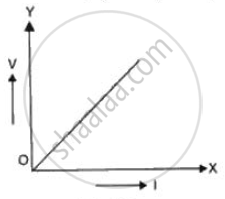
A graph is plotted taking p.d. along y-axis and electric current along x-axis. Name the physical quantity that represents the slope of this graph (Fig.).
When do you say that the resistors are connected in this way? Draw a circuit diagram.
What is the equivalent resistance between the points X and Y for the given network?
Calculate the value of the resistance which must be connected to a 15 ohm resistance to provide on effective resistance of 6 ohm.
