Advertisements
Advertisements
Question
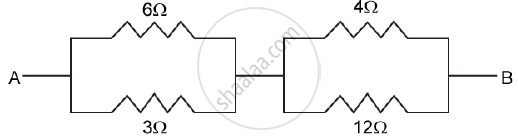
Find the equivalent resistance between A and B
Advertisements
Solution
6Ω and 3Ω are in parallel
`:.1/R_p= 1/R_1 + 1/R_2`
`:.R_(P_1) = 6.3/(6+3) = 18/9` = 2 Ω
4Ω and 2Ω are in parallel
`:. 1/R_P = 1/R_1 + 1/R_2`
`:. R_(P_2) = 4.12/(4+12) = 4.12/16 = 3 Ω`
`:. "Total" R_T = R_(P_1) + R_(P_2) = 2 + 3 = 5 Ω`
APPEARS IN
RELATED QUESTIONS
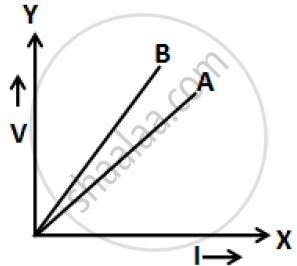
The V-I graph for a series combination and for a parallel combination of two resistors is shown in the figure below. Which of the two A or B. represents the parallel combination? Give reasons for your answer.
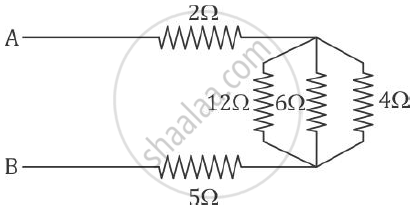
Find the equivalent resistance between points A and B.
Write down an expression for the resistance of a metallic wire in terms of the resistivity.
Choose the correct alternative and rewrite the following sentence.
If three resistors 2 ohms, 3 ohms and 4 ohms are connected in series, then the effective resistance in the circuit will be _______ ohms.
When do you say that the resistors are connected in this way? Draw a circuit diagram.
State a relation between electrical power, resistance and potential difference in an electrical circuit.
2Ω resistor A, 1Ω resistor B and 4Ω resistor C are connected in parallel. The combination is connected across a 2V battery of negligible resistance. Draw the diagram of the arrangement and calculate:
(i) The current in each resistor A and C,
(ii) The current through battery.
Two resistors of 4Ω and 6Ω are connected in parallel to a cell to draw 0.5 A current from the cell.
Draw a labelled circuit diagram showing the above arrangement.
Calculate the value of the resistance which must be connected to a 15 ohm resistance to provide on effective resistance of 6 ohm.
