Advertisements
Advertisements
Question
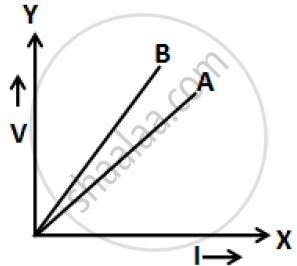
The V-I graph for a series combination and for a parallel combination of two resistors is shown in the figure below. Which of the two A or B. represents the parallel combination? Give reasons for your answer.
Advertisements
Solution 1
For the same change in I, change in V is less for the straight line A than for the straight line B (i.e. the straight line A is less steeper than B). The straight line A represents small resistance, while the straight line B represents more resistance. The equivalent resistance is less in a parallel combination than in a series combination. So, line A represents a parallel combination.
Solution 2
‘A’ shows parallel combination because in case of parallel combination, the resistance is less for their potential is less, currents is more.
APPEARS IN
RELATED QUESTIONS
Complete the following :-
(a)

Two resistors of 4Ω and 6 Ω are connected in parallel to a cell to draw 0.5 A current from the cell.
(i) Draw a labelled circuit diagram showing the above arrangement.
(ii) Calculate the current in each resistor. What is an Ohmic resistor?
How does the presence of impurities in a metal affect its resistance?
State the order of resistivity of (i) a metal, (ii) a semiconductor and (iii) an insulator.
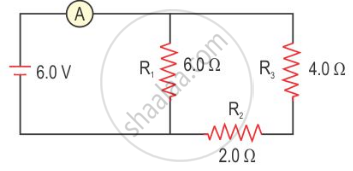
Three resistors of 6.0 Ω, 2.0 Ω and 4.0 Ω are joined to an ammeter A and a cell of emf 6.0 V as shown in the following figure. Calculate :
- the effective resistance of the circuit.
- the reading of ammeter.
State a relation between electrical power, resistance and potential difference in an electrical circuit.
You are provided with three resistors of resistance 1.0 Ω, 2.0 Ω and 3.0 Ω How would you connect them to obtain the total effective resistance 1.5 Ω? Draw diagram of the arrangement and check it by calculations.
Four resistances of 2.0Ω each are joined end to end, to form a square ABCD. Calculate the equivalent resistance of the combination between any two adjacent comers.
