Advertisements
Advertisements
प्रश्न
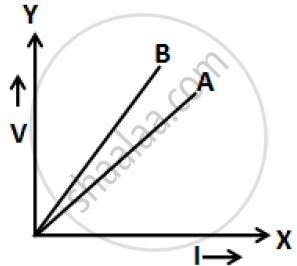
The V-I graph for a series combination and for a parallel combination of two resistors is shown in the figure below. Which of the two A or B. represents the parallel combination? Give reasons for your answer.
Advertisements
उत्तर १
For the same change in I, change in V is less for the straight line A than for the straight line B (i.e. the straight line A is less steeper than B). The straight line A represents small resistance, while the straight line B represents more resistance. The equivalent resistance is less in a parallel combination than in a series combination. So, line A represents a parallel combination.
उत्तर २
‘A’ shows parallel combination because in case of parallel combination, the resistance is less for their potential is less, currents is more.
APPEARS IN
संबंधित प्रश्न
How does the resistance of a wire change when:
its length is tripled?
Give the law of combination of resistances in series.
What possible values of resultant resistance one can get by combining two resistances, one of value 2 ohm and the other 6 ohm?
State the order of resistivity of (i) a metal, (ii) a semiconductor and (iii) an insulator.
Why are thick copper wires used as connecting wires?
How does the resistivity of an alloy such as constantace depends on temperature.
Define the term resistivity and state its S.I. unit. Which will have higher resistivity a conductor or an insulator.
State expression for Resistance connected in series.
State and explain the laws of resistance.
Calculate the value of the resistance which must be connected to a 15 ohm resistance to provide on effective resistance of 6 ohm.
