Advertisements
Advertisements
प्रश्न
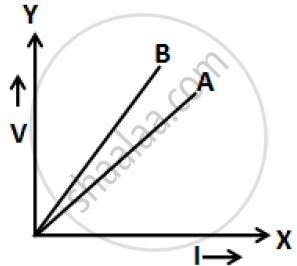
The V-I graph for a series combination and for a parallel combination of two resistors is shown in the figure below. Which of the two A or B. represents the parallel combination? Give reasons for your answer.
Advertisements
उत्तर १
For the same change in I, change in V is less for the straight line A than for the straight line B (i.e. the straight line A is less steeper than B). The straight line A represents small resistance, while the straight line B represents more resistance. The equivalent resistance is less in a parallel combination than in a series combination. So, line A represents a parallel combination.
उत्तर २
‘A’ shows parallel combination because in case of parallel combination, the resistance is less for their potential is less, currents is more.
APPEARS IN
संबंधित प्रश्न
In series combination which remains constant?
(a) Voltage
(b) Current
(c) Both current and voltage
(d) Both are variables
Find the expression for resistors connected in series.
Judge the equivalent resistance when the following are connected in parallel − (a) 1 Ω and 106Ω, (b) 1 Ω and 103Ω and 106Ω.
Write down an expression for the resistance of a metallic wire in terms of the resistivity.
Calculate the resistance of an aluminium cable of length 10 km and diameter 2.0 mm if the resistivity of aluminium is 27 × 10−8 Ωm.
Give the law of combination of resistances in series.
A given metallic wire of resistance R is doubled on itself. What will be its new resistance?
State expression for Resistance connected in parallel.
2Ω resistor A, 1Ω resistor B and 4Ω resistor C are connected in parallel. The combination is connected across a 2V battery of negligible resistance. Draw the diagram of the arrangement and calculate:
(i) The current in each resistor A and C,
(ii) The current through battery.
With the help of a circuit diagram derive the formula for the resultant resistance of three resistances connected:
- in series and
- in parallel
