Advertisements
Advertisements
प्रश्न
Give the law of combination of resistances in series.
Advertisements
उत्तर
APPEARS IN
संबंधित प्रश्न
If the equivalent resistance is to be increased, then the number of resistances should be connected in
- Series
- Parallel
- Mixed arrangement
- None of the above
Judge the equivalent resistance when the following are connected in parallel − (a) 1 Ω and 106Ω, (b) 1 Ω and 103Ω and 106Ω.
A piece of wire of resistance R is cut into five equal parts. These parts are then connected in parallel. If the equivalent resistance of this combination is R’, then the ratio `"R"/"R'"` is ______.
When a 4 Ω resistor is connected across the terminals of a 12 V battery, the number of coulombs passing through the resistor per second is:
(a) 0.3
(b) 3
(c) 4
(d) 12
Name the material which is used for making the heating element of an electric iron.
How does the presence of impurities in a metal affect its resistance?
How does the resistance of a wire change when:
its length is tripled?
If two resistors of 25 Ω and 15 Ω are joined together in series and then placed in parallel with a 40 Ω resistor, the effective resistance of the combination is :
(a) 0.1 Ω
(b) 10 Ω
(c) 20 Ω
(d)40 Ω
Name the following substance showing low resistivity.
What is the equivalent resistance between A and B in the given circuit (Fig?)
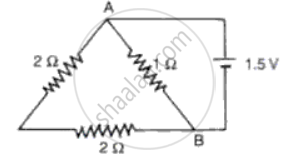
How will you oonnect five resistors, each of the value one ohm, to obtain an equivalent resistance of 0.2 `Omega`
How does the resistivity of an alloy such as constantace depends on temperature.
Six resistances are connected together as shown in the figure. Calculate the equivalent resistance between points A and B.
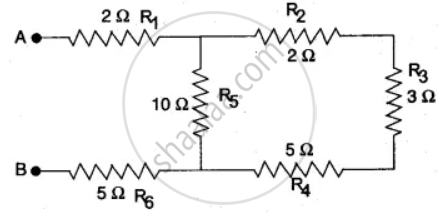
Two resistors of 4Ω and 6Ω are connected in parallel to a cell to draw 0.5 A current from the cell.
Draw a labelled circuit diagram showing the above arrangement.
Two resistors having 2Ω and 3Ω resistance are connected—(i) in series, and (ii) in parallel. Find the equivalent resistance in each case.
If R1 and R2 be the resistance of the filament of 40 W and 60 W respectively operating 220 V, then:
Two electric bulbs have resistances in the ratio 1 : 2. If they are joined in series, the energy consumed in them is in the ratio:
