Advertisements
Advertisements
प्रश्न
How will you oonnect five resistors, each of the value one ohm, to obtain an equivalent resistance of 0.2 `Omega`
Advertisements
उत्तर
Five resistors each of value 1 ohm s hou Id be connected in paral le I to obtain an equivalent resistance of O. 2 ohm.
Equivalent parallel resistance RP = `("Resistance of each resistor"/"No. of resistors") = 1/5 = 0.2 Omega`
APPEARS IN
संबंधित प्रश्न
In series combination which remains constant?
(a) Voltage
(b) Current
(c) Both current and voltage
(d) Both are variables
If the equivalent resistance is to be increased, then the number of resistances should be connected in
- Series
- Parallel
- Mixed arrangement
- None of the above
Judge the equivalent resistance when the following are connected in parallel − (a) 1 Ω and 106Ω, (b) 1 Ω and 103Ω and 106Ω.
Why is the series arrangement not used for domestic circuits?
What possible values of resultant resistance one can get by combining two resistances, one of value 2 ohm and the other 6 ohm?
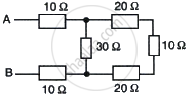
What is the resistance between A and B in the figure given below?
Choose the correct alternative and rewrite the following sentence.
If three resistors 2 ohms, 3 ohms and 4 ohms are connected in series, then the effective resistance in the circuit will be _______ ohms.
Choose the correct alternative and rewrite the following:
You are given three equal resistances. In how many combinations can they are arranged?
Answer the following question.
While studying the dependence of potential difference ( V) across a resistor on the current (I) passing through it, in order to determine the resistance of the resistor, a student took 5 readings for different values of current and plotted a graph between V and t. He got a straight line graph passing through the origin. What does the straight-line signify? Write the method of determining the resistance of the resister using this graph.
Six equal resistors of 1 ohm each are connected to form the sides of a hexagon ABCDEF. Calculate the resistance offered by the combination if the current enters at A and leaves it at D.
