Advertisements
Advertisements
प्रश्न
Illustrate-combination of cells e.g., three cells, in series, explaining the combination briefly. Obtain an expression for current ‘i’ in the combination.
Advertisements
उत्तर
Combination of cells in series:

In this combination, the cells are so connected that the negative terminal of one cell is connected to the positive terminal of the other cell such that in the end one free positive and one free negative terminal are left. These free terminals are connected to the external circuit. If the e.m.f of each cell is E and Y be the internal resistance and I be the current, then e.m.f. of the cell in series = nE (here n = 3)
The total internal resistance = nr
and External resistance = R
∴ Current I in the external circuit `= "Total e.m.f."/"Total resistance of the circuit"`
I = `"nE"/"nr + R"`
If r is very small, then neglecting r, we get I = `"nE"/"R"`
This shows that it is advantageous to connect cells in series to get a large current when their internal resistance is negligible.
संबंधित प्रश्न
A piece of wire of resistance R is cut into five equal parts. These parts are then connected in parallel. If the equivalent resistance of this combination is R’, then the ratio `"R"/"R'"` is ______.
If five resistances, each of value 0.2 ohm, are connected in series, what will be the resultant resistance?
If two resistors of 25 Ω and 15 Ω are joined together in series and then placed in parallel with a 40 Ω resistor, the effective resistance of the combination is :
(a) 0.1 Ω
(b) 10 Ω
(c) 20 Ω
(d)40 Ω
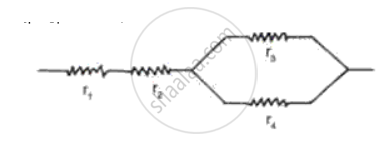
Calculate the equivalent resistance of the following combination of resistor r1, r2, r3, and r4
How does the resistivity of an alloy such as constantace depends on temperature.
What is the equivalent resistance between the points X and Y for the given network?
Two wires of the same length and area made of two materials of resistivity ρ1 and ρ2 are connected in series to a source of potential V. The equivalent resistivity for the same area is:
Two electric bulbs have resistances in the ratio 1 : 2. If they are joined in series, the energy consumed in them is in the ratio:
