Advertisements
Advertisements
प्रश्न
Show how you would connect three resistors, each of resistance 6 Ω, so that the combination has a resistance of 4 Ω.
Advertisements
उत्तर
If we connect the resistors in series, then the equivalent resistance will be the sum of the resistors, i.e., 6 Ω + 6 Ω + 6 Ω = 18 Ω, which is not desired. If we connect the resistors in parallel, then the equivalent resistance will be `6/2` = 3 Ω is also not desired. Hence, we should either connect the two resistors in series or parallel.
Two resistors in series:
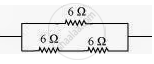
Two 6 Ω resistors are in series. Their equivalent resistance will be the sum 6 + 6 = 12 Ω.
The third 6 Ω resistor is in parallel with 12 Ω. Hence, equivalent resistance will be
`1/(1/12+1/6)=(12xx6)/(12+6)=4Omega.`
Therefore, the total resistance is 4 Ω.
संबंधित प्रश्न
Find the expression for the resistors connected in series and write the two characteristics of it. (Draw figure).
Judge the equivalent resistance when the following are connected in parallel − (a) 1 Ω and 106Ω, (b) 1 Ω and 103Ω and 106Ω.
A battery of 9 V is connected in series with resistors of 0.2 Ω, 0.3 Ω, 0.4 Ω, 0.5 Ω and 12 Ω, respectively. How much current would flow through the 12 Ω resistor?
An electrical appliance has a resistance of 25 Ω. When this electrical appliance is connected to a 230 V supply line, the current passing through it will be:
(a) 0.92 A
(b) 2.9 A
(c) 9.2 A
(d) 92 A
How does the presence of impurities in a metal affect its resistance?
State the order of resistivity of (i) a metal, (ii) a semiconductor and (iii) an insulator.
Name a substance of which the resistance remains almost unchanged by the increase in temperature.
To increase the effective resistance in a circuit, the resistors are connected in _______________ .
Choose the correct alternative and rewrite the following:
You are given three equal resistances. In how many combinations can they are arranged?
A given metallic wire of resistance R is doubled on itself. What will be its new resistance?
Bends in a rubber pipe reduce the flow of water through it. How would the bands in a wire affect its electric resistance?
Name the material of wire used for making standard resistances. Give a reason.
Why are thick copper wires used as connecting wires?
State the effect of rise in temperature on the resistance of semi-conductors.
How does the resistivity of a semiconductor depend on temperature?
How does the resistivity of an alloy such as constantace depends on temperature.
State expression for Resistance connected in series.
Write an expression for calculating electrical power in terms of current and resistance.
Calculate the equivalent resistance between the points A and B for the following combination of resistors:
Three resistors of 6Ω, 3Ω and 2Ω are connected together so that their total resistance is greater than 6Ω but less than 8Ω Draw a diagram to show this arrangement and calculate its total resistance.
Two lamps of resistance 30Ω and 20Ω respectively are connected in series in a 110V circuit. Calculate:
(i) the total resistance in the circuit
(ii) the current in the circuit, and
(iii) the voltage drop across each lamp.
Calculate the quantity of heat that will be produced in a coil of resistance 75 Ω if a current of 2A is passed through it for 2 minutes.
Two wires of same material and same lengths have radii in the ratio of 2 : 3, Compare their resistances.
Two wires of the same length and area made of two materials of resistivity ρ1 and ρ2 are connected in series to a source of potential V. The equivalent resistivity for the same area is:
The resistance of the hot filament of the bulb is about 10 times the cold resistance. What will be the resistance of 100 W-220 V lamps, when not in use?
