Advertisements
Advertisements
Question
Show how you would connect three resistors, each of resistance 6 Ω, so that the combination has a resistance of 4 Ω.
Advertisements
Solution
If we connect the resistors in series, then the equivalent resistance will be the sum of the resistors, i.e., 6 Ω + 6 Ω + 6 Ω = 18 Ω, which is not desired. If we connect the resistors in parallel, then the equivalent resistance will be `6/2` = 3 Ω is also not desired. Hence, we should either connect the two resistors in series or parallel.
Two resistors in series:
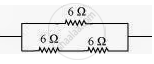
Two 6 Ω resistors are in series. Their equivalent resistance will be the sum 6 + 6 = 12 Ω.
The third 6 Ω resistor is in parallel with 12 Ω. Hence, equivalent resistance will be
`1/(1/12+1/6)=(12xx6)/(12+6)=4Omega.`
Therefore, the total resistance is 4 Ω.
RELATED QUESTIONS
In series combination which remains constant?
(a) Voltage
(b) Current
(c) Both current and voltage
(d) Both are variables
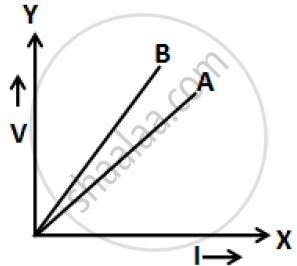
The V-I graph for a series combination and for a parallel combination of two resistors is shown in the figure below. Which of the two A or B. represents the parallel combination? Give reasons for your answer.
An electrical appliance has a resistance of 25 Ω. When this electrical appliance is connected to a 230 V supply line, the current passing through it will be:
(a) 0.92 A
(b) 2.9 A
(c) 9.2 A
(d) 92 A
If the length of a wire is doubled by taking more of wire, what happens to its resistance?
Name the material which is the best conductor of electricity.
How does the resistance of a wire change when:
its diameter is tripled?
What is (a) highest, and (b)Ω lowest, resistance which can be obtained by combining four resistors having the following resistances?
4 Ω, 8 Ω, 12 Ω, 24 Ω
You are supplied with a number of 100 Ω resistors. How could you combine some of these resistors to make a 250 Ω resistor?
State how are the two resistors joined with a battery when equivalent resistance is more than either of the two resistances.
What potential difference is needed to drive a current o f 1 A through a 5 Ω resistor?
How will you oonnect five resistors, each of the value one ohm, to obtain an equivalent resistance of 0.2 `Omega`
To increase the effective resistance in a circuit, the resistors are connected in _______________ .
Choose the correct alternative and rewrite the following sentence.
If three resistors 2 ohms, 3 ohms and 4 ohms are connected in series, then the effective resistance in the circuit will be _______ ohms.
Answer the following question.
While studying the dependence of potential difference ( V) across a resistor on the current (I) passing through it, in order to determine the resistance of the resistor, a student took 5 readings for different values of current and plotted a graph between V and t. He got a straight line graph passing through the origin. What does the straight-line signify? Write the method of determining the resistance of the resister using this graph.
A given metallic wire of resistance R is doubled on itself. What will be its new resistance?
State the effect of rise in temperature on the resistance of semi-conductors.
Define the term resistivity and state its S.I. unit. Which will have higher resistivity a conductor or an insulator.
State a relation between electrical power, resistance and potential difference in an electrical circuit.
What is a resistance? Define it with respect to Ohm’s law,
Six resistances are connected together as shown in the figure. Calculate the equivalent resistance between points A and B.
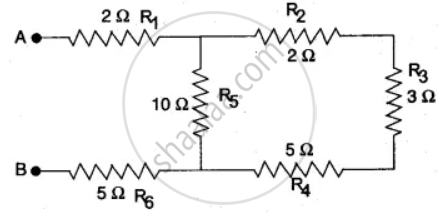
In the circuit shown below, calculate the equivalent resistance between the points (i) A and B, (ii) C and D.
Illustrate-combination of cells e.g., three cells, in series, explaining the combination briefly. Obtain an expression for current ‘i’ in the combination.
A metal wire of resistance 6 Ω is stretched so that its length is increased to twice its original length. Calculate its new resistance.
Two wires of the same length and area made of two materials of resistivity ρ1 and ρ2 are connected in series to a source of potential V. The equivalent resistivity for the same area is:
In an electrical circuit, two resistors of 2 Ω and 4 Ω respectively are connected in series to a 6 V battery. The heat dissipated by the 4 Ω resistor in 5 s will be ______.
Consider the following combinations of resistors:


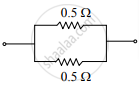
The combinations having equivalent resistance 1 Q is/are ______.
