Advertisements
Advertisements
Question
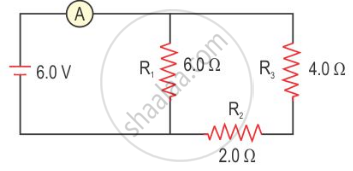
Three resistors of 6.0 Ω, 2.0 Ω and 4.0 Ω are joined to an ammeter A and a cell of emf 6.0 V as shown in the following figure. Calculate :
- the effective resistance of the circuit.
- the reading of ammeter.
Advertisements
Solution
From circuit diagram
R3 and R2 are in series
R3 = i.e 4 + 2 = 6 Ω
Now R3 and R1 are in parallel
- Total resistance = `1/"R" = 1/6 + 1/6`
= `2/6` or
R = `6/2 `
= 3 Ω - I = `"V"/"R"`
= `6.0/3.0`
= 2 A
APPEARS IN
RELATED QUESTIONS
A p.d. of 4 V is applied to two resistors of 6 Ω and 2 Ω connected in series. Calculate:
(a) the combined resistance
(b) the current flowing
(c) the p.d. across the 6 Ω resistor
In series combination of resistances ______.
What do you mean by power rating of an electrical appliance? How do you use it to calculate
(a) the resistance of the appliance and
(b) the safe limit of the current in it, while in use?
Why are thick copper wires used as connecting wires?
The voltage applied to a given rheostat is made four times its initial value. By what factor will be resistance of the rheostat change?
The resistance of two resistors joined in series is 8Ω and in parallel is 1.5Ω. Find the value of the two resistances.
Two wires of the same length and area made of two materials of resistivity ρ1 and ρ2 are connected in series to a source of potential V. The equivalent resistivity for the same area is:
The resistance of the hot filament of the bulb is about 10 times the cold resistance. What will be the resistance of 100 W-220 V lamps, when not in use?
