Advertisements
Advertisements
Question
A given metallic wire of resistance R is doubled on itself. What will be its new resistance?
Advertisements
Solution
When a given metallic wire is doubled on itself, its length is reduced to half, but its area of cross-section gets doubled. So, the resistance of the wire will become one-fourth i.e., the new resistance of wire will be R/4 (or 0.25 R).
RELATED QUESTIONS
When a 4 Ω resistor is connected across the terminals of a 12 V battery, the number of coulombs passing through the resistor per second is:
(a) 0.3
(b) 3
(c) 4
(d) 12
How does the resistance of a pure metal change if its temperature decreases?
In series combination of resistances ______.
How does the resistivity of a semiconductor depend on temperature?
State and explain the laws of resistance.
Six resistances are connected together as shown in the figure. Calculate the equivalent resistance between points A and B.
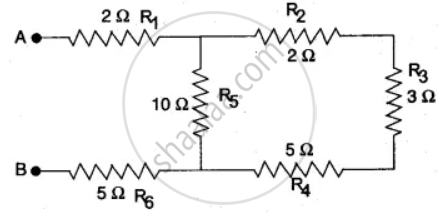
Two wires of same material and same lengths have radii in the ratio of 2 : 3, Compare their resistances.
