Advertisements
Advertisements
प्रश्न
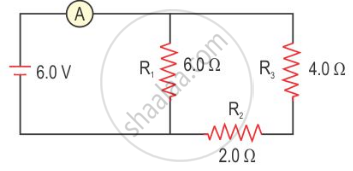
Three resistors of 6.0 Ω, 2.0 Ω and 4.0 Ω are joined to an ammeter A and a cell of emf 6.0 V as shown in the following figure. Calculate :
- the effective resistance of the circuit.
- the reading of ammeter.
Advertisements
उत्तर
From circuit diagram
R3 and R2 are in series
R3 = i.e 4 + 2 = 6 Ω
Now R3 and R1 are in parallel
- Total resistance = `1/"R" = 1/6 + 1/6`
= `2/6` or
R = `6/2 `
= 3 Ω - I = `"V"/"R"`
= `6.0/3.0`
= 2 A
APPEARS IN
संबंधित प्रश्न
How does the resistance of a wire change when:
its diameter is tripled?
Draw a V-I graph for a conductor at two different temperatures. What conclusion do you draw from your graph for the variation of resistance of conductor with temperature?
Choose the correct alternative and rewrite the following:
You are given three equal resistances. In how many combinations can they are arranged?
Name the material of wire used for making standard resistances. Give a reason.
Calculate the value of the resistance which must be connected to a 15 ohm resistance to provide on effective resistance of 6 ohm.
Two wires of the same length and area made of two materials of resistivity ρ1 and ρ2 are connected in series to a source of potential V. The equivalent resistivity for the same area is:
If R1 and R2 be the resistance of the filament of 40 W and 60 W respectively operating 220 V, then:
What is the maximum resistance which can be made using five resistors each of `1/5` W?
