Advertisements
Advertisements
प्रश्न
The circuit diagram Fig shows three resistors 2 Ω, 4 Ω and R Ω connected to a battery of e.m.f. 2 V and internal resistance 3 Ω. If main current of 0.25 A flows through the circuit, find:
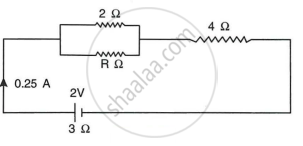
- the p.d. across the 4 Ω resistor,
- the p.d. across the internal resistance of the cell,
- the p.d. across the R Ω or 2 Ω resistors
- the value of R.
Advertisements
उत्तर
Current I = 0.25 A = `1/4` A,
(i) Potential difference across the 4Ω resistor = current through the resistor × its resistance
= 0.25 × 4
= 1V
(ii) Potential difference across internal resistance= current through internal resistance × internal resistance
= 0.25 × 3
= 0.75V
(iii) P.d. across the R Ω or 3 Ω resistor= emf - (p.d. across 4Ω resistor + p.d. across internal resistance)
= 2 - (1 + 0.75)
= 0.25V
(iv) We know, e = I `[("r" + 4 Ω) + (1/2 + 1/"R")^-1]`
2 = 0.25 `[7 + (2"R"/"R" + 2)]`
or, `(2"R")/("R" + 2) = 1`
or 2R = R + 2
or R = 2 Ω
APPEARS IN
संबंधित प्रश्न
Show how you would connect two 4 ohm resistors to produce a combined resistance of (a) 2 ohms (b) 8 ohms.
A resistor has a resistance of 176 ohms. How many of these resistors should be connected in parallel so that their combination draws a current of 5 amperes from a 220 volt supply line?
A 4 Ω coil and a 2 Ω coil are connected in parallel. What is their combined resistance? A total current of 3 A passes through the coils. What current passes through the 2 Ω coil?
An electrical appliance has a rating 100 W, 120V. The resistance of element of appliance when in use:
A current of 2 A is passed through a coil of resistance 75 Ω for 2 minutes.
(a) How much heat energy is produced?
(b) How much charge is passed through the resistance?
How does the resistance of a metallic wire depend on the length of wire?
How does the resistance of a metallic wire depend on the thickness of wire?
A given wire is stretched to double its length. How will its resistance change?
A piece of wire of resistance R is cut into three equal parts. These parts are then connected in parallel. If the equivalent resistance of this parallel combination is R1, what is the value of the ratio R1 : R?
Four resistors each of resistance 5 Ω are connected in parallel. What is the effective resistance?
