Advertisements
Advertisements
प्रश्न
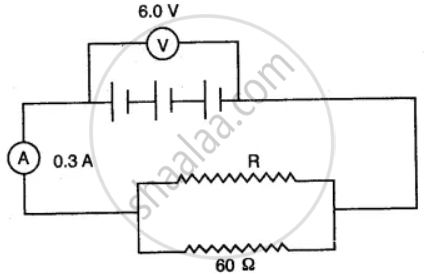
In the figure below, the ammeter A reads 0.3 A. Calculate:
(i) the total resistance of the circuit
(ii) the value of R
(iii) the current flowing through R.
Advertisements
उत्तर
(i) ∵ V = IR
∴ R = `"V"/"I" = 6.0/0.3 = 20 Ω`
(ii) Total resistance = 20 Ω
∵ Resistance in parallel
∴ `1/20 = 1/"R" + 1/60`
`1/"R" = 1/20 - 1/60`
`1/"R" = (3 - 1)/60`
R = `60/2 = 30 `Ω
(iii) ∵ V = IR
and potential (V) is equal at the two ends i.e. A and B
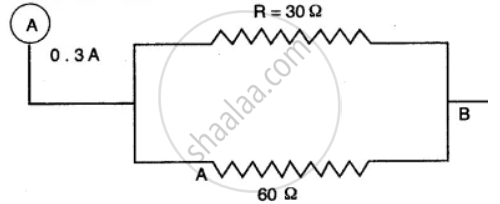
Let I1 be current flowing through R
∴ (0.3 - I1) is current flowing through 60 Ω resistance.
Now V = V ⇒ I1R1 = I2R2
I1 × 30 = (0.3 - I1) × 60
I1 = 0.6 - 2I1
3I1 = 0.6
I1 = `0.6/3 = 0.2`
∴ Current flowing through R = 0.2 A
संबंधित प्रश्न
A wire that has resistance R is cut into two equal pieces. The two parts are joined in parallel. What is the resistance of the combination?
In the diagram shown alongside, the cell and the ammeter both have negligible resistance. The resistors are identical.
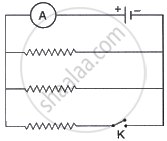
With the switch K open, the ammeter reads 0.6 A. What will be the ammeter reading when the switch is closed?
Four resistors each of resistance 2Ω are connected in parallel. What is the effective resistance?
A battery of e.m.f 16 V and internal resistance 2 Ω is connected to two resistors 3Ω and 6Ω connected in parallel. Find:
- the current through the battery.
- p.d. between the terminals of the battery,
- the current in 3 Ω resistors,
- the current in 6 Ω resistor.
Show how would you connect three resistors, each of resistance 6 O so that
the combination has a resistance of(a) 9 Ω (b) 4 .Ω
Tick (✓) the correct choice among the following :
Consider two cases of two parallel current carrying conductors. Current in
th e same direction and currents in th e opposi te directions will produce
A cell supplies a current of 1.2 A through two 2Ω resistors connected in parallel. When the resistors are connected in series, if supplies a current of 0.4 A. Calculate the internal resistance and e.m.f of the cell.
An electrical appliance having a resistance of 200 Ω is operated at 200 V. Calculate the energy consumed by the appliance in 5 minutes in kWh.
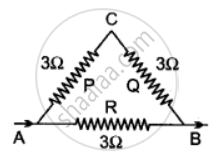
Calculate equivalent resistance in the following cases:
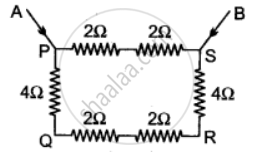
A piece of wire of resistance R is cut into three equal parts. These parts are then connected in parallel. If the equivalent resistance of this parallel combination is R1, what is the value of the ratio R1 : R?
