Advertisements
Advertisements
प्रश्न
Four resistors each of resistance 2Ω are connected in parallel. What is the effective resistance?
Advertisements
उत्तर
R1 = 2 ohm
R2 = 2 ohm
R3 = 2 ohm
R4 = 2 ohm
`1/R=1/R_1+1/R_2+1/R_3+1/R_4`
=`1/2+1/2+1/2+1/2=2`
R = 0.5 ohm
संबंधित प्रश्न
Two resistors, with resistance 5 Ω and 10 Ω respectively are to be connected to a battery of emf 6 V so as to obtain:
(i) minimum current flowing
(ii) maximum current flowing
(a) How will you connect the resistances in each case?
(b) Calculate the strength of the total current in the circuit in the two cases.
Two resistances when connected in parallel give resultant value of 2 ohm; when connected in series the value becomes 9 ohm. Calculate the value of each resistance.
Two resistors having resistance 4𝛀 and 6𝛀 are connected in parallel. Find their equivalent resistance.
Calculate the equivalent resistance between the points A and B in Fig. if each resistance is 2·0 Ω.

A battery of e.m.f. 15 V and internal resistance 2 `Omega` is connected to two resistors of 4 ohm and 6 ohm joined.
(i) In series,
(ii) In parallel.
Find in each case the electrical energy spent per minute in 6 ohm resistor.
Explain, why is the p.d. between the terminals of a storage battery less when it is supplying current than when it is on open circuit. A battery of e.m.f. 10 volts and internal resistance 2.5 ohms has two resistances of 50 ohms each connected to it. Calculate the power dissipated in each resistance
(a) When they are in series,
(b) When they are in parallel.
In each case calculate the power dissipated in the battery.
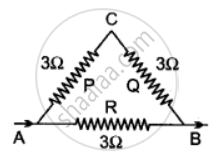
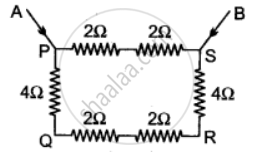
Calculate equivalent resistance in the following cases:
What connection is used in domestic appliances and why?
Assertion: When a battery is short circuited, the terminal voltage is zero.
Reason: In a short circuit, the current is zero.
Two resistors of resistance 2 Ω and 3 Ω are connected in parallel to a cell to draw current 0.5 A from the cell. Calculate the current in each resistor.
