Advertisements
Advertisements
प्रश्न
A cell supplies a current of 1.2 A through two 2Ω resistors connected in parallel. When the resistors are connected in series, if supplies a current of 0.4 A. Calculate the internal resistance and e.m.f of the cell.
Advertisements
उत्तर
(i) The effective resistance of a circuit with two 20-ohm resistors linked in parallel is R is `1/"R" = 1/2 + 1/2`
∴ R = 1Ω
'r' stands for the internal resistance of the cell that is in series with the circuit.
∴ V = IR
or V = 1.2 (1 + r) ...(i)
Connected in series, the effective resistance of the two resistors and the cell's internal resistance, denoted as 'r'
R = 2 + 2 + r
= (4 + r) Ω ...(ii)
V = IR
= 0.4 (4 + R)
(i) = (ii)
1.2 (1 + r) = 0.4 (4 + r)
1.2 + 1.2 r = 1.6 + 0.4 r
or (1.2 - 0.4) r = (1.6 - 1.2)
0.8 r = 0.4
r = `0.4/0.8`
= `1/2`
= 0.5 Ω
put r = 0.5 in (i)
(ii) e.m.f. of cell E = V = 1.2 (1 + 0.5) = 1.8 V
संबंधित प्रश्न
What are the advantages of connecting electrical devices in parallel with the battery instead of connecting them in series?
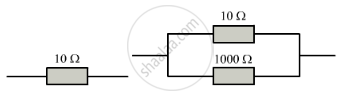
Which of the following arrangement, A or B, has the lower combined resistance?
A wire that has resistance R is cut into two equal pieces. The two parts are joined in parallel. What is the resistance of the combination?
Two resistances when connected in parallel give resultant value of 2 ohm; when connected in series the value becomes 9 ohm. Calculate the value of each resistance.
A resistor of 8 ohms is connected in parallel with another resistor X. The resultant resistance of the combination is 4.8 ohms. What is the value of the resistor X?
How will you connect three resistors of resistances 2 Ω, 3 Ω, and 6 Ω to obtain a total resistance of 4 Ω, and 1 Ω?
State how are the two resistors joined with a battery when potential difference is same across each resistor.
An electrical appliance having a resistance of 200 Ω is operated at 200 V. Calculate the energy consumed by the appliance in 5 minutes in kWh.
Four resistors each of resistance 5 Ω are connected in parallel. What is the effective resistance?
