Advertisements
Advertisements
प्रश्न
You have three resistors of values 2Ω, 3Ω and 5Ω. How will you join them so that the total resistance is less than 1Ω? Draw diagram and find the total resistance.
Advertisements
उत्तर
The three resistors should be connected in parallel
To get a total resistance less than 1Ω
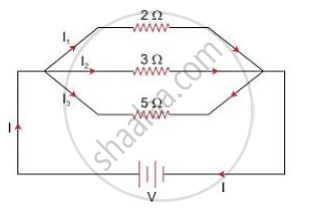
In parallel, if the equivalent resistance is RP, then
`therefore 1/R_p = 1/R_1 + 1/R_2 + 1/R_3`
`therefore 1/R_p =1/2+1/3+1/5`
`therefore 1/R_p = (15+10+6)/30`
`therefore 1/R_p = 31/30`
⇒ `R_p = 30/31 = 0.97 Ω`
संबंधित प्रश्न
With a neat labelled diagram and derive the equation for three resistances connected in parallel.
A hot plate of an electric oven connected to a 220 V line has two resistance coils A and B, each of 24 Ω resistances, which may be used separately, in series, or in parallel. What are the currents in the three cases?
In the circuit given below:
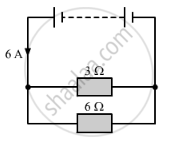
(a) What is the combined resistance?
(b) What is the p.d. across the combined resistor?
(c) What is the p.d. across the 3 Ω resistor?
(d) What is the current in the 3 Ω resistor?
(e) What is the current in the 6 Ω resistor?
A wire of resistance R1 is cut into five equal pieces. These five pieces of wire are then connected in parallel. If the resultant resistance of this combination be R2, then the ratio `R_1/R_2` is:
(a) `1/25`
(b)1/5
(c)5
(c)25
How will you connect three resistors of 2 Ω, 3 Ω and 5 Ω respectively so as to obtain a resultant of 2.5 Ω? Draw the diagram to show the arrangement.
Two resistors having resistance 4𝛀 and 6𝛀 are connected in parallel. Find their equivalent resistance.
Four resistors each of resistance 2Ω are connected in parallel. What is the effective resistance?
A particular resistance wire has a resistance of 3 ohm per meter. Find :
The total resistance of three lengths of this wire each 1.5 m long, in parallel.
How does the resistance of a metallic wire depend on the length of wire?
Calculate equivalent resistance in the following cases: