Advertisements
Advertisements
प्रश्न
A piece of wire having a resistance R is cut into five equal parts.
- How will the resistance of each part of the wire change compared with the original resistance?
- If the five parts of the wire are placed in parallel, how will the resistance of the combination change?
- What will be ratio of the effective resistance in series connection to that of the parallel connection?
Advertisements
उत्तर
- Consider a piece of wire having resistance R. It was cut into 5 equal parts. So number of equal resistors is 5. n = 5
When ‘n’ resistors of equal resistance R are connected in series, the equivalent resistance is ‘nR’
RS = nR
⇒ RS = 5R
⇒ R = `R_s/5`
⇒ R = 0.2 RS
Each part of resistance ‘R’ is equal to 0.2 times the original resistance. - Effective Resistance of 5 Resistors
`1/R_P = 1/R + 1/R + 1/R + 1/R + 1/R = 5/R`
`R_P = R/5` = 0.2 R - Effective resistance of series combination RS = 5R
Effective resistance of parallel combination
`R_P = R/5`
The ratio of series connection to the parallel connection
`R_S/R_P = (5 R)/(R//S)`
(2) (9 - R2 - + R2) = (9 - R2)R2
`R_S/R_P = 5 R xx 5/R = 25`
RS : RP = 25 : 1
APPEARS IN
संबंधित प्रश्न
How can three resistors of resistances 2 Ω, 3 Ω and 6 Ω be connected to give a total resistance of 4 Ω ?
Several electric bulbs designed to be used on a 220 V electric supply line are rated 10 W. How many lamps can be connected in parallel with each other across the two wires of 220 V line if the maximum allowable current is 5 A?
State the law of combination of resistances in parallel.
A wire that has resistance R is cut into two equal pieces. The two parts are joined in parallel. What is the resistance of the combination?
Are the lights in your house wired in series?
If current flows through two lamps arranged:
(a) in series,
(b) in parallel,
and the filament of one lamps breaks, what happens to the other lamp? Explain your answer.
Two resistors having resistance 4𝛀 and 6𝛀 are connected in parallel. Find their equivalent resistance.
The circuit diagram Fig shows three resistors 2 Ω, 4 Ω and R Ω connected to a battery of e.m.f. 2 V and internal resistance 3 Ω. If main current of 0.25 A flows through the circuit, find:
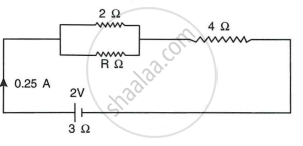
- the p.d. across the 4 Ω resistor,
- the p.d. across the internal resistance of the cell,
- the p.d. across the R Ω or 2 Ω resistors
- the value of R.
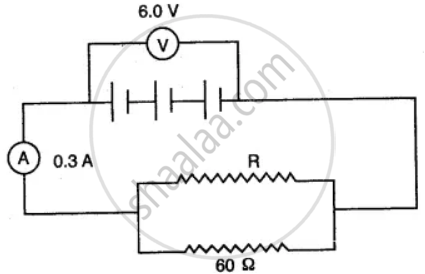
In the figure below, the ammeter A reads 0.3 A. Calculate:
(i) the total resistance of the circuit
(ii) the value of R
(iii) the current flowing through R.
What connection is used in domestic appliances and why?
