Advertisements
Advertisements
Question
A piece of wire having a resistance R is cut into five equal parts.
- How will the resistance of each part of the wire change compared with the original resistance?
- If the five parts of the wire are placed in parallel, how will the resistance of the combination change?
- What will be ratio of the effective resistance in series connection to that of the parallel connection?
Advertisements
Solution
- Consider a piece of wire having resistance R. It was cut into 5 equal parts. So number of equal resistors is 5. n = 5
When ‘n’ resistors of equal resistance R are connected in series, the equivalent resistance is ‘nR’
RS = nR
⇒ RS = 5R
⇒ R = `R_s/5`
⇒ R = 0.2 RS
Each part of resistance ‘R’ is equal to 0.2 times the original resistance. - Effective Resistance of 5 Resistors
`1/R_P = 1/R + 1/R + 1/R + 1/R + 1/R = 5/R`
`R_P = R/5` = 0.2 R - Effective resistance of series combination RS = 5R
Effective resistance of parallel combination
`R_P = R/5`
The ratio of series connection to the parallel connection
`R_S/R_P = (5 R)/(R//S)`
(2) (9 - R2 - + R2) = (9 - R2)R2
`R_S/R_P = 5 R xx 5/R = 25`
RS : RP = 25 : 1
APPEARS IN
RELATED QUESTIONS
Differentiate between resistances in series and parallel.
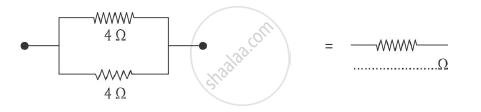
Complete the following :-
(b)
Several electric bulbs designed to be used on a 220 V electric supply line are rated 10 W. How many lamps can be connected in parallel with each other across the two wires of 220 V line if the maximum allowable current is 5 A?
Show how would you join three resistors, each of resistance 9 Ω so that the equivalent resistance of the combination is
1) 13.5
2) 6 Ω
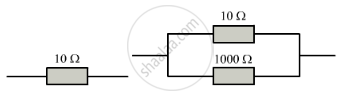
Which of the following arrangement, A or B, has the lower combined resistance?
A resistor has a resistance of 176 ohms. How many of these resistors should be connected in parallel so that their combination draws a current of 5 amperes from a 220 volt supply line?
An electric heater which is connected to a 220 V supply line has two resistance coils A and B of 24 Ω resistance each. These coils can be used separately (one at a time), in series or in parallel. Calculate the current drawn when:
(a) only one coil A is used.
(b) coils A and B are used in series.
(c) coils A and B are uses in parallel.
Explain with the help of a labelled circuit diagram, how you will find the resistance of a combination of three resistors of resistances R1, R2 and R3 joined in parallel.
An electrical appliance having a resistance of 200 Ω is operated at 200 V. Calculate the energy consumed by the appliance in 5 minutes in kWh.
How does the resistance of a metallic wire depend on the length of wire?
