Advertisements
Advertisements
Question
A wire that has resistance R is cut into two equal pieces. The two parts are joined in parallel. What is the resistance of the combination?
Advertisements
Solution
A wire that has a resistance, R is cut into two equal pieces.
The resistance of the each piece will be `R/2`
The two parts, each of resistance, R/2 are joined in parallel.
The resistance of the parallel combination:
`1/R^rho=1/R=1/R_1+1/R_2`
`Here R^1=R/2`
`=R_2=R/2`
`1/Rrho=1/(R/2)+1/(R/2)`
`1/Rrho=2/R+2/R`
`1/Rrho=4//R`
`Rrho=R/4`
Thus, the resistance of the combination will be R/4.
APPEARS IN
RELATED QUESTIONS
Complete the following :-
(c)

With a neat labelled diagram and derive the equation for three resistances connected in parallel.
A hot plate of an electric oven connected to a 220 V line has two resistance coils A and B, each of 24 Ω resistances, which may be used separately, in series, or in parallel. What are the currents in the three cases?
Explain with diagram what is meant by the "series combination" and "parallel combination" of resistances. In which case the resultant resistance is : (i) less, and (ii) more, than either of the individual resistances?
A resistor has a resistance of 176 ohms. How many of these resistors should be connected in parallel so that their combination draws a current of 5 amperes from a 220 volt supply line?
A wire of resistance R1 is cut into five equal pieces. These five pieces of wire are then connected in parallel. If the resultant resistance of this combination be R2, then the ratio `R_1/R_2` is:
(a) `1/25`
(b)1/5
(c)5
(c)25
Two resistances when connected in parallel give resultant value of 2 ohm; when connected in series the value becomes 9 ohm. Calculate the value of each resistance.
A resistor of 8 ohms is connected in parallel with another resistor X. The resultant resistance of the combination is 4.8 ohms. What is the value of the resistor X?
State how are the two resistors joined with a battery when potential difference is same across each resistor.
Two resistors having resistance 4𝛀 and 6𝛀 are connected in parallel. Find their equivalent resistance.
Calculate the equivalent resistance between the points A and B in Fig. if each resistance is 2·0 Ω.

A particular resistance wire has a resistance of 3 ohm per meter. Find the total resistance of three lengths of this wire each 1.5 m long, joined in parallel.
The equivalent resistance of a parallel combination of two resistors of 30 Ω and 60 Ω is ______________.
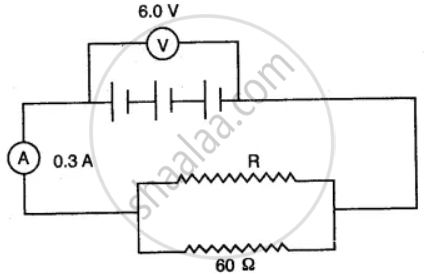
In the figure below, the ammeter A reads 0.3 A. Calculate:
(i) the total resistance of the circuit
(ii) the value of R
(iii) the current flowing through R.
The least resistance obtained by using 2 Ω, 4 Ω, 1 Ω and 100 Ω is:
Three resistors of 6Ω, 4Ω and 4Ω are connected together so that the total resistance is 8Ω. Draw a diagram to show this arrangement and give reason to justify your answer.
A piece of wire of resistance R is cut into three equal parts. These parts are then connected in parallel. If the equivalent resistance of this parallel combination is R1, what is the value of the ratio R1 : R?
Two resistors having resistance 8 Ω and 12 Ω are connected in parallel. Find their equivalent resistance.
