Advertisements
Advertisements
Question
Two resistors having resistance 8 Ω and 12 Ω are connected in parallel. Find their equivalent resistance.
Advertisements
Solution
Let R be the equivalent resistance
∴ `1/"R" = 1/"R"_1 + 1/"R"_2`
`1/"R" = 1/8 + 1/12`
= `(3 +2)/24`
`1/"R" = 5/24`
R = `24/5`
= 4.8 Ω
or R = `("R"_1"R"_2)/("R"_1 + "R"_2)`
= `(8 xx 12)/((8 + 12))`
= 4.8 Ω

APPEARS IN
RELATED QUESTIONS
How many 176 Ω resistors (in parallel) are required to carry 5 A on a 220 V line?
State the law of combination of resistances in parallel.
Show how you would connect two 4 ohm resistors to produce a combined resistance of (a) 2 ohms (b) 8 ohms.
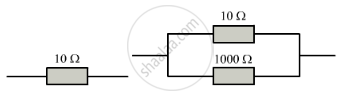
Which of the following arrangement, A or B, has the lower combined resistance?
Calculate the equivalent resistance between the points A and B in Fig. if each resistance is 2·0 Ω.

A particular resistance wire has a resistance of 3 ohm per meter. Find the total resistance of three lengths of this wire each 1.5 m long, joined in parallel.
The circuit diagram Fig shows three resistors 2 Ω, 4 Ω and R Ω connected to a battery of e.m.f. 2 V and internal resistance 3 Ω. If main current of 0.25 A flows through the circuit, find:
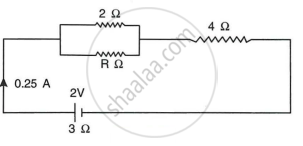
- the p.d. across the 4 Ω resistor,
- the p.d. across the internal resistance of the cell,
- the p.d. across the R Ω or 2 Ω resistors
- the value of R.
An electrical appliance having a resistance of 200 Ω is operated at 200 V. Calculate the energy consumed by the appliance in 5 minutes in kWh.
A coil in the heater consumes power P on passing current. If it is cut into halves and joined in parallel, it will consume power:

The diagram above is a schematic diagram of a household circuit. The house shown in the above diagram has 5 usable spaces where electrical connections are made. For this house, the mains have a voltage of 220 V and the net current coming from the mains is 22A.
- What is the mode of connection to all the spaces in the house from the mains?
- The spaces 5 and 4 have the same resistance and spaces 3 and 2 have respective resistances of 20Ω and 30Ω. Space 1 has a resistance double that of space 5. What is the net resistance for space 5.
- What is the current in space 3?
- What should be placed between the main connection and the rest of the house’s electrical appliances to save them from accidental high electric current?
