Advertisements
Advertisements
Question
In parallel combination of resistances ______.
Options
p.d. is same across each resistance
total resistance is increased
current is same in each resistance
all of the above are true
Advertisements
Solution
In parallel combination of resistances p.d. is same across each resistance.
Explanation:
In parallel combination, the ends of each resistor are connected to the ends of the same source of potential. Thus, the potential difference across each resistance is same and is equal to the potential difference across the terminals of the source (or battery).
APPEARS IN
RELATED QUESTIONS
How many 176 Ω resistors (in parallel) are required to carry 5 A on a 220 V line?
Show how you would connect three resistors, each of resistance 6 Ω, so that the combination has a resistance of 9 Ω.
Several electric bulbs designed to be used on a 220 V electric supply line are rated 10 W. How many lamps can be connected in parallel with each other across the two wires of 220 V line if the maximum allowable current is 5 A?
The figure given below shows three resistors?
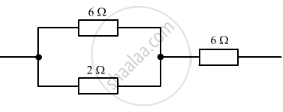
Their combined resistance is:
(a) `1 5/7`Ω
(b) `14` Ω
(c) `6 2/3` Ω
(d) `7 1/2` Ω
Two resistances when connected in parallel give resultant value of 2 ohm; when connected in series the value becomes 9 ohm. Calculate the value of each resistance.
How will you connect three resistors of resistances 2 Ω, 3 Ω, and 6 Ω to obtain a total resistance of 4 Ω, and 1 Ω?
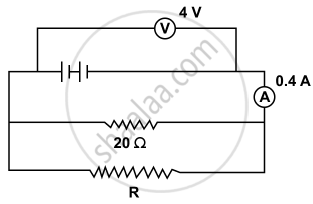
In the following figure calculate:
- the total resistance of the circuit
- the value of R, and
- the current flowing in R.
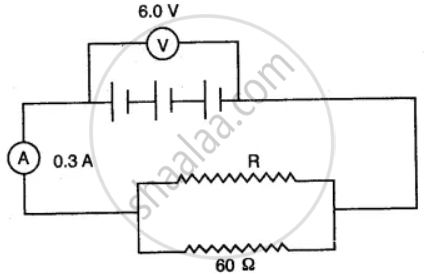
In the figure below, the ammeter A reads 0.3 A. Calculate:
(i) the total resistance of the circuit
(ii) the value of R
(iii) the current flowing through R.
What connection is used in domestic appliances and why?
The least resistance obtained by using 2 Ω, 4 Ω, 1 Ω and 100 Ω is:
