Advertisements
Advertisements
Question
How will you connect three resistors of 2 Ω, 3 Ω and 5 Ω respectively so as to obtain a resultant of 2.5 Ω? Draw the diagram to show the arrangement.
Advertisements
Solution
To get the resistance of 2.5 Î, we will have to connect the resistors of values 2 Î and 3 Î in series and this arrangement should be connected in parallel with the resistor of value 5 Î.
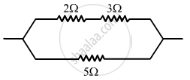
Resistance 2 Ω and 3 Ω are in series their net resistance is `R=R_1+R_2`
R=2Ω+3Ω
R=5Ω
This 5 Ω resistance is in parallel with another 5 Ω resistance therefore their net resistance is:'
`1/R=1/R_1+1/R_1`
`1/R=1/5+1/5`
1/R=2/5
R=2.5Ω Hence, net resistance of the combination will be 2.5 Ω
APPEARS IN
RELATED QUESTIONS
Complete the following :-
(c)

With a neat labelled diagram and derive the equation for three resistances connected in parallel.
How can three resistors of resistances 2 Ω, 3 Ω and 6 Ω be connected to give a total resistance of 4 Ω ?
Which of the following arrangement, A or B, has the lower combined resistance?
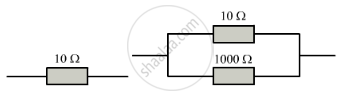
Explain with the help of a labelled circuit diagram, how you will find the resistance of a combination of three resistors of resistances R1, R2 and R3 joined in parallel.
In the diagram shown alongside, the cell and the ammeter both have negligible resistance. The resistors are identical.
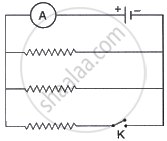
With the switch K open, the ammeter reads 0.6 A. What will be the ammeter reading when the switch is closed?
If current flows through two lamps arranged:
(a) in series,
(b) in parallel,
and the filament of one lamps breaks, what happens to the other lamp? Explain your answer.
In parallel combination of resistances ______.
Which of the following combinations have the same equivalent resistance between X and Y?
You have three resistors of values 2Ω, 3Ω and 5Ω. How will you join them so that the total resistance is less than 1Ω? Draw diagram and find the total resistance.
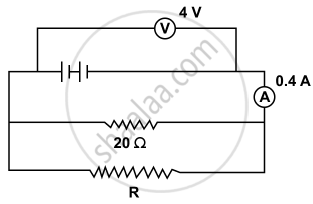
In the following figure calculate:
- the total resistance of the circuit
- the value of R, and
- the current flowing in R.
A battery of e.m.f. 15 V and internal resistance 2 `Omega` is connected to two resistors of 4 ohm and 6 ohm joined.
(i) In series,
(ii) In parallel.
Find in each case the electrical energy spent per minute in 6 ohm resistor.
What are the advantages of a parallel connection?
A particular resistance wire has a resistance of 3 ohm per meter. Find :
The total resistance of three lengths of this wire each 1.5 m long, in parallel.
The equivalent resistance of a parallel combination of two resistors of 30 Ω and 60 Ω is ______________.
How does the resistance of a metallic wire depend on the thickness of wire?
A coil in the heater consumes power P on passing current. If it is cut into halves and joined in parallel, it will consume power:
Four resistors each of resistance 5 Ω are connected in parallel. What is the effective resistance?
Two resistors of resistance 2 Ω and 3 Ω are connected in parallel to a cell to draw current 0.5 A from the cell. Calculate the current in each resistor.
