Advertisements
Advertisements
Question
How does the resistance of a metallic wire depend on the thickness of wire?
Advertisements
Solution
The resistance of a wire decreases with increase in its thickness (R ∝ l/a where a = πr2, the area of cross-section of the wire).
RELATED QUESTIONS
How can three resistors of resistances 2 Ω, 3 Ω and 6 Ω be connected to give a total resistance of 4 Ω ?
A hot plate of an electric oven connected to a 220 V line has two resistance coils A and B, each of 24 Ω resistances, which may be used separately, in series, or in parallel. What are the currents in the three cases?
Show how would you join three resistors, each of resistance 9 Ω so that the equivalent resistance of the combination is
1) 13.5
2) 6 Ω
In the diagram shown alongside, the cell and the ammeter both have negligible resistance. The resistors are identical.
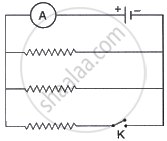
With the switch K open, the ammeter reads 0.6 A. What will be the ammeter reading when the switch is closed?
The figure given below shows three resistors?
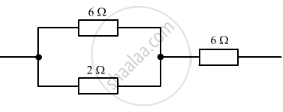
Their combined resistance is:
(a) `1 5/7`Ω
(b) `14` Ω
(c) `6 2/3` Ω
(d) `7 1/2` Ω
Two resistances when connected in parallel give resultant value of 2 ohm; when connected in series the value becomes 9 ohm. Calculate the value of each resistance.
A resistor of 8 ohms is connected in parallel with another resistor X. The resultant resistance of the combination is 4.8 ohms. What is the value of the resistor X?
Show how would you connect three resistors, each of resistance 6 O so that
the combination has a resistance of(a) 9 Ω (b) 4 .Ω
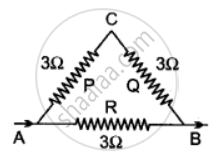
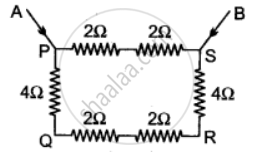
Calculate equivalent resistance in the following cases:
You have three resistors of values 2 Ω, 3 Ω, and 5 Ω. How will you join them so that the total resistance is less than 1 Ω? Draw a diagram and find the total resistance.
