Advertisements
Advertisements
Question
State the S.I. unit of electrical resistance and define it.
Advertisements
Solution
The S.I. unit of electrical resistance is ohm (Ω). The resistance of a conductor is said to be 1 ohm if 1 ampere current flows through it when the potential difference across its end is 1 volt.
RELATED QUESTIONS
How many 176 Ω resistors (in parallel) are required to carry 5 A on a 220 V line?
Show how you would connect two 4 ohm resistors to produce a combined resistance of (a) 2 ohms (b) 8 ohms.
A 4 Ω coil and a 2 Ω coil are connected in parallel. What is their combined resistance? A total current of 3 A passes through the coils. What current passes through the 2 Ω coil?
The figure given below shows three resistors?
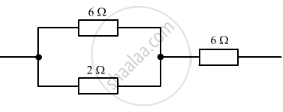
Their combined resistance is:
(a) `1 5/7`Ω
(b) `14` Ω
(c) `6 2/3` Ω
(d) `7 1/2` Ω
A particular resistance wire has a resistance of 3 ohm per meter. Find the total resistance of three lengths of this wire each 1.5 m long, joined in parallel.
How does the resistance of a metallic wire depend on the thickness of wire?
A given wire is stretched to double its length. How will its resistance change?
A piece of wire having a resistance R is cut into five equal parts.
- How will the resistance of each part of the wire change compared with the original resistance?
- If the five parts of the wire are placed in parallel, how will the resistance of the combination change?
- What will be ratio of the effective resistance in series connection to that of the parallel connection?
You are given four ammeters A, B, C and D having the least counts mentioned below:
(I) Ammeter A with least count 0.25 A
(II) Ammeter B with least count 0.5 A
(III) Ammeter C with least count 0.05 A
(IV) Ammeter D with least count 0.1 A
Which of the ammeters would you prefer for doing an experiment to determine the equivalent resistance of two resistances most accurately, when connected in parallel?
Two resistors of resistance 2 Ω and 3 Ω are connected in parallel to a cell to draw current 0.5 A from the cell. Calculate the current in each resistor.
