Advertisements
Advertisements
प्रश्न
State the S.I. unit of electrical resistance and define it.
Advertisements
उत्तर
The S.I. unit of electrical resistance is ohm (Ω). The resistance of a conductor is said to be 1 ohm if 1 ampere current flows through it when the potential difference across its end is 1 volt.
संबंधित प्रश्न
Complete the following :-
(c)

A resistor of 8 ohms is connected in parallel with another resistor X. The resultant resistance of the combination is 4.8 ohms. What is the value of the resistor X?
How will you connect three resistors of resistances 2 Ω, 3 Ω, and 6 Ω to obtain a total resistance of 4 Ω, and 1 Ω?
State how are the two resistors joined with a battery when equivalent resistance is less than either of the two resistances.
Calculate the equivalent resistance between the points A and B in Fig. if each resistance is 2·0 Ω.

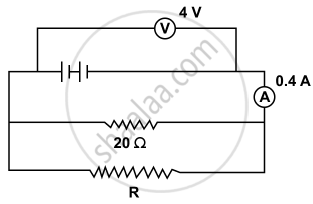
In the following figure calculate:
- the total resistance of the circuit
- the value of R, and
- the current flowing in R.
What is the equivalent resistance of 5 equal resistors, each of value 2`Omega` 1 when oonnected in (a) Series ( b) ParaIleI?
What are the advantages of a parallel connection?
Two resistors of resistance 2 Ω and 3 Ω are connected in parallel to a cell to draw current 0.5 A from the cell. Calculate the current in each resistor.
